About the Bebras Challenge
Across the world, including Finland, in-school enrichment initiatives play a vital role in complementing formal education, giving students access to the most up-to-date knowledge and digital skills. Among these initiatives, the Bebras Challenge stands out as a global phenomenon. Its engaging approach to computational thinking has made it incredibly popular worldwide, and it continues to be warmly embraced in Finland as well.
The international Bebras Challenge on Informatics and Computational Thinking is a challenge established in 2004 by Prof. Valentina Dagienė from Vilnius University, Lithuania. The Bebras Challenge is an international initiative aiming to promote informatics and computational thinking among school students of all ages. The Challenge is organised annually, and in 2024, 74 countries organised it with nearly 4 million participants. The Challenge has been organized in Finland since 2010. The Challenge is known as Majava-kilpailu in Finnish or Bäver-tävlingen in Swedish, as bebras is a Lithuanian word for beaver and majava in Finnish and bäver in Swedish.
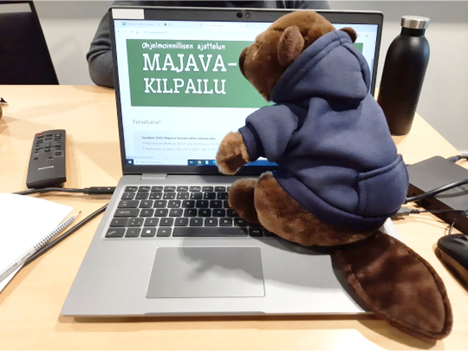 A beaver represents the Bebras Challenge, symbolizing the clever problem-solving skills the competition encourages.
Bebras Challenge Workshop
As November approaches each year, students eagerly await the challenge lesson, an hour packed with fun, interactive tasks. Before the challenge can begin, a significant amount of work takes place behind the scenes. The tasks are new every year and are created by the international Bebras community, which brings together informatics teachers, researchers, and other experts. Each task is short, typically solvable in about three minutes, and the set offers a balanced mix of interactive problems, traditional multiple-choice questions, and open-ended challenges. While no programming is required, the tasks are grounded in the core principles of programming and computer science.
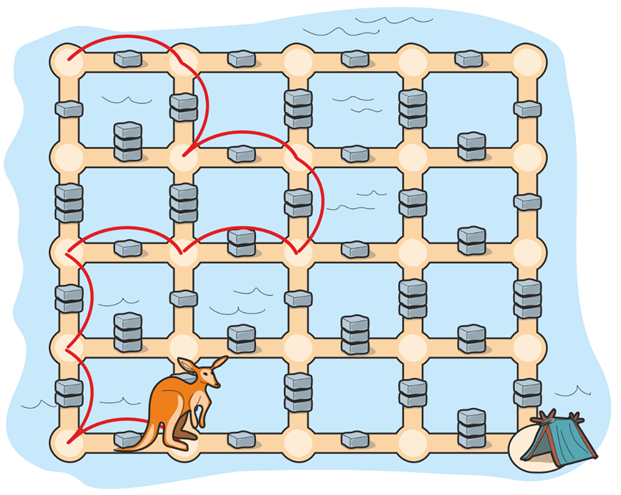 Interactive task from a couple of years ago: Find the route to the tent, avoiding three-brick high obstacles.
In Finland, the Challenge is organised in collaboration between Tampere University and the University of Turku. In late October 2025, organisers from both universities met to finalise the preparations and refine the task translations into Finnish and Swedish. The workshop proved fruitful not only for completing the challenge setup but also for fostering discussions on future research directions.
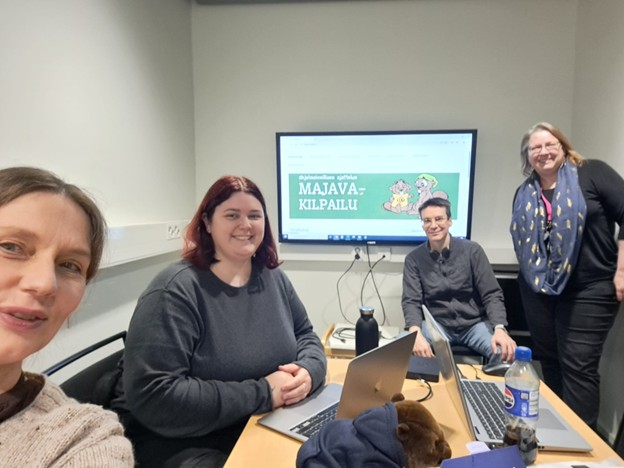 Dr. Heikki Hyyrö and Dr Pia Niemelä from Tampere University worked together with doctoral researchers Heidi Kaarto and Marika Parviainen from the University of Turku.
The Bebras Challenge in Finland is organised in collaboration between multiple countries known as the BeLLE Consortium. The goal of the Consortium is to transform the Bebras Challenge into an international research and assessment platform in addition to its original goal of promoting informatics and computational thinking to students. In 2025, there are nearly thirty countries involved in the Consortium.
Within the BeLLE Consortium, Doctoral Researcher Heidi Kaarto from Turku Research Institute for Learning Analytics, University of Turku, is conducting research about the Bebras Challenge for her PhD dissertation. The results show that the Challenge is indeed quite challenging, and that there are small but interesting differences between girls and boys.
Summary
The Bebras Challenge gives students a fun, engaging way to develop computational thinking and problem-solving skills and helps students build important digital skills. The challenge is inclusive, accessible to all age groups, and offered in Finnish and Swedish in Finland. Students also benefit from being part of a global initiative, with peers from nearly 74 countries participating each year. Behind the scenes, educators and researchers carefully design the tasks to be stimulating and age-appropriate, ensuring a high-quality learning experience.
Research within the BeLLE Consortium provides insights into how students approach the problems and highlights small but interesting differences in performance between girls and boys. By participating in the Bebras Challenge, students gain confidence, curiosity, and a sense of achievement. More than just a single lesson, it is an engaging step into the world of computational thinking and computer science, connecting learners in Finland to a vibrant international community.
References:
majava-kilpailu.fi (cited 28.10.2025)
Bebras (cited 28.10.2025)