From the upcoming school year, Croatian students will have the opportunity to choose a new elective subject focused on artificial intelligence. As reported by Dnevnik.hr, the subject aims to introduce students to how AI works, where we encounter it in everyday life, and how to use it responsibly.
This announcement is an important signal: AI is no longer a distant or future topic – it is becoming part of formal education. But introducing AI into schools is not just a question of adding a new subject. It raises a much bigger and more important question: what kind of AI education do we actually want for young people?
AI literacy is not only technical literacy
When we talk about teaching AI, the focus often immediately shifts to tools, applications, and technical concepts. While these are important, they are only one part of the picture.
Young people already interact with AI daily – through social media algorithms, recommendation systems, search engines, filters, chatbots, and generative AI tools. The key educational challenge is not whether students will use AI, but whether they will understand, question, and critically reflect on it.
AI education, therefore, needs to go beyond:
- learning how AI systems work,
- experimenting with tools,
- understanding basic concepts like data and algorithms.
It must also include:
- ethical questions (fairness, bias, responsibility),
- privacy and data protection,
- the impact of AI on democracy, work, creativity, and relationships,
- critical thinking and informed decision-making.
The role of teachers: support matters
Introducing AI into the curriculum also puts teachers at the centre of this transition. Many educators are highly motivated and curious, but they are also navigating rapidly changing technologies, unclear expectations, and uneven access to training and resources.
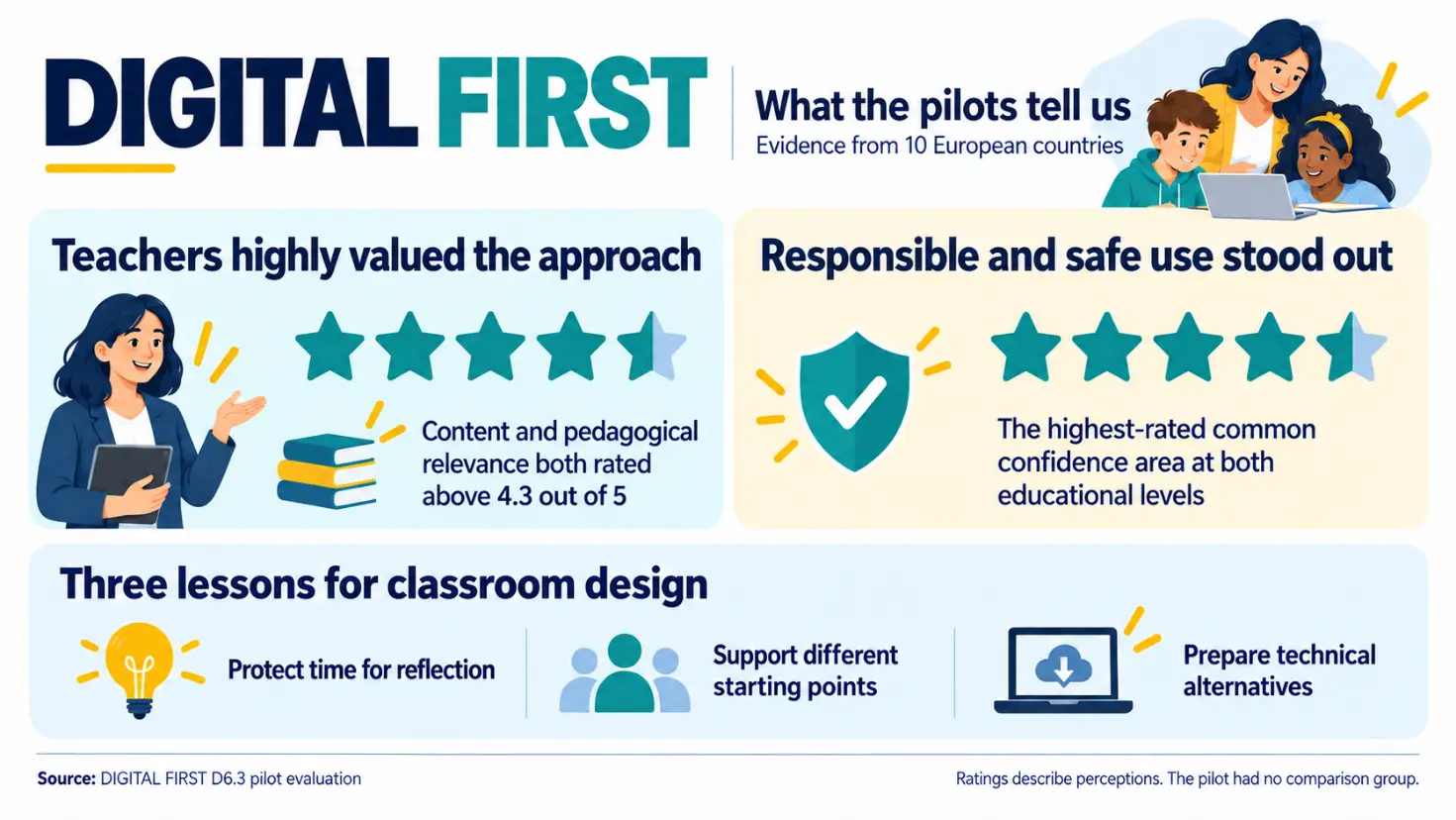
Research conducted within the Digital First project shows that across Europe, informatics and digital education often depend heavily on individual teacher initiative rather than systemic support. This makes teacher education and continuous professional development a critical factor for meaningful AI education.
If AI is introduced as an elective subject, teachers need:
- clear pedagogical frameworks,
- practical, classroom-ready materials,
- training that connects technology with ethics and digital citizenship,
- space to adapt content to students’ real experiences.
From “learning about AI” to becoming ethical digital citizens
At Digital First, we see this development as an opportunity, not just to teach about AI, but to rethink how digital technologies are taught more broadly.
AI education should help students:
- ask better questions, not just get faster answers,
- recognise when technology supports them and when it shapes or limits them,
- understand that technology is designed by people and can be changed,
- see themselves as active digital citizens, not passive users.
The introduction of an AI elective subject is a promising step. Its real value, however, will depend on how thoughtfully it is designed, taught, and supported and whether it empowers young people to navigate a digital world with confidence, responsibility, and critical awareness.