When the DIGITAL FIRST learning scenarios reached classrooms in ten European countries, they met two very different audiences: primary pupils still discovering what technology can do, and secondary students who already live much of their lives online. What they told us after the pilot holds a useful lesson for anyone who wants students to use technology to say something, not only to operate it. The same idea can engage both groups, but it rarely works the same way for both.
One idea, two audiences
DIGITAL FIRST treats digital technology as a language, something we use to express ourselves, communicate, investigate, create and solve problems, not only a set of technical rules to memorise. Inspired by the functions of language, the project defines seven functions of technology: personal (expressing who we are), interactional (relating to others), representational (informing), instrumental (getting things done), imaginative (creating), heuristic (investigating) and regulatory (acting responsibly). Each scenario is built around one of these purposes, not around a tool. During the pilots, primary and secondary teachers in Bulgaria, Croatia, Cyprus, Finland, Greece, Italy, Lithuania, Portugal, Slovenia and Spain used scenarios built on this idea, covering topics such as media literacy, digital identity, online safety, artificial intelligence, programming and digital creativity.
At the end of the pilot, students rated their experience:
- whether the activities kept their interest,
- whether the materials were clear,
- whether the tools helped them learn, and
- whether the tasks encouraged them to explore further.
Both groups were positive overall. However, the tone of their answers was quite different:
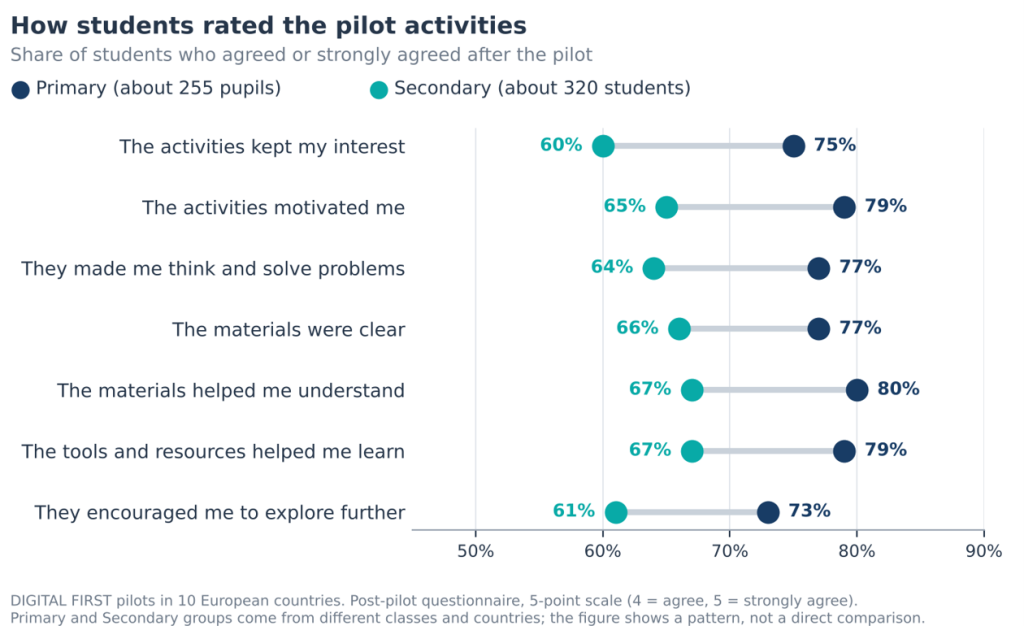
Figure 1. Share of primary and secondary students who agreed or strongly agreed with each statement about the pilot activities. Source: DIGITAL FIRST pilot evaluation (D6.3), post-pilot student questionnaires.
Younger pupils: guided, motivated and confident
Among primary pupils, enthusiasm was broad and consistent. About four in five agreed the materials helped them understand (80%), the activities motivated them (79%), and the tools and resources supported their learning (79%). No aspect of the experience stood out as a weak point: clarity, motivation and learning support rose and fell together.
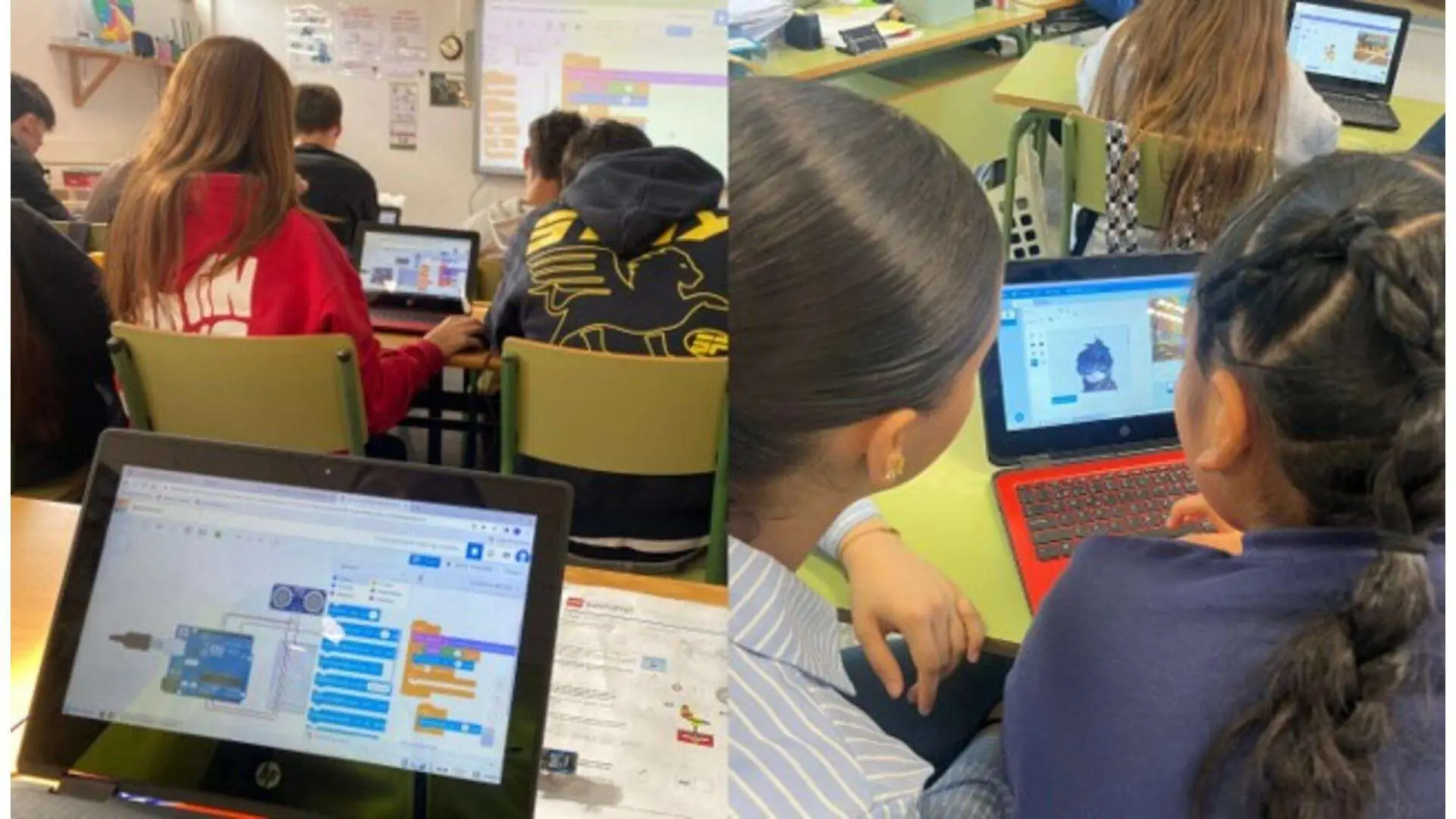
This positive picture did not happen by itself. Teachers’ reports show how much work lay behind it: they gave more direct guidance, simplified instructions and broke tasks into smaller steps. Younger pupils responded well to activities that were concrete, guided and close to their everyday experience, such as thinking about what they share online or who they are in a digital space.
Teenagers: positive, but harder to impress
Secondary students were also positive, but more selective. About two in three agreed with most statements. They gave their highest ratings to the relevance of the tools and resources and to materials that supported understanding (67% each). Their lowest ratings were for whether the activities kept their interest (60%) and encouraged them to explore further (61%).
This should not be read as a rejection of the approach. Teenagers recognised the value of what they were doing, but they also judged the activities more critically. When a task felt too basic, too long for the time available or too complicated to set up, they said so. What they seemed to be asking for was a real problem worth solving and a level of challenge that matched what they already know.
Three scenes from the classroom
The national pilot reports bring these patterns to life. In Finland, the contrast between levels was especially clear. Primary pupils gave positive ratings, while a secondary group designing a game in Minecraft Education, an activity built around the imaginative function, gave much lower scores. The teacher’s account explains why:
- the tool was complex,
- the instructions were not always clear, and
- four lessons were not enough to master it.
The idea was sound, but the conditions were not.
In Spain and Lithuania, time was the recurring challenge. Spanish teachers found their media literacy and digital creativity activities, linked to the representational and imaginative functions, meaningful, but they had to adjust them to fit 45-minute lessons. Lithuanian teachers faced a similar problem when a computational thinking task, linked to the heuristic function, moved from simple problem cards to a programming concept that was too demanding for the planned sequence. In both cases, teachers shortened tasks, prepared examples in advance or postponed parts of the scenario so that the core of the activity could still happen.
In Cyprus, secondary students worked on the personal function, exploring digital identity and self-expression. They also gave a glimpse of what learning beyond the activity can look like. One student described using artificial intelligence to help structure an essay and find sources, while remaining responsible for the writing. Others mentioned using what they had learned for school projects and class presentations. These are individual accounts rather than measured results, but they show the kind of transfer the project hopes to encourage.
Older students also had views on how they wanted to work. In Finland, secondary students asked to work in pairs or small groups, while their teacher preferred individual work to make sure everyone took part. Both positions are reasonable, and both point to the same need: collaboration works best when roles are clear and every student has a part to play.
Across these scenes, what mattered was not the tool but whether students knew what they were using it for. One detail is telling. Confidence in expressing themselves through technology was the lowest-rated confidence item at both levels, although still positive. Students created and shared, but did not always see this as a form of expression. When the function stays implicit, an activity can be enjoyable without being understood as learning a language. Naming the function, and asking students what they want to say or find out, is part of the design.
One activity, two routes
What can a teacher take from these experiences? The pilot evaluation suggests that a single scenario does not need to be identical for every learner. Its core can stay the same, the function of technology being practised (expressing, communicating, investigating, creating), a purpose students can put into words, a product to share and time to reflect on it. What changes is the route.
For younger pupils, a model product, a guided first step and short, clear stages help them get started with confidence. For teenagers, a real-life problem, more autonomy and a challenge that stretches them can make the difference between doing an activity and caring about it. In both cases, the same practical conditions matter: a core that fits a real lesson, accounts and devices checked in advance, and optional extensions rather than overloaded sessions.
Looking ahead
DIGITAL FIRST continues to share its results with teachers, schools and policymakers across Europe. What sets this approach apart is not that students enjoyed new activities, since novelty often motivates. It is that technology was treated as a way to express, communicate, investigate and create, just as a language is learned by using it. This can work across ages, with guidance for the youngest and a real challenge for teenagers. For all of them, the starting point is knowing what they want to say or do with technology.