The European Erasmus+ DIGITAL FIRST project (Digital Tech as the First Language: Informatics for Digital Natives) aims to transform the way informatics is taught and experienced in European schools, promoting a functional approach to digital technology as a true first language for digital natives.
In Portugal, in close partnership with the European consortium, the teacher training centre Centro de Formação de Associação de Escolas dos Concelhos de Póvoa de Varzim e Vila do Conde (CFAE-PVVC) has played an active role in bringing this vision into practice.
Throughout 2026, teacher training and pilot activities in Portuguese schools provided an opportunity to explore how the functional approach to informatics can be translated into meaningful classroom experiences.
Teacher Training and Pilot Preparation
The operational phase began in January 2026 with the delivery of teacher training sessions, organised as short-duration accredited training courses, held on 21 and 28 January at CFAE-PVVC facilities.
The sessions involved eight informatics teachers in the analysis of the learning scenarios developed by the consortium and in the adaptation of the functional approach to informatics, centred on why and how digital technologies serve human activity through seven functions:
- Personal
- Representational
- Interactional
- Instrumental
- Imaginative
- Heuristic
- Regulatory
This approach encourages teachers to move beyond a purely technical view of technology education and explore how digital technologies can support meaningful learning and everyday activities.
Bringing the Functional Approach into Portuguese Classrooms
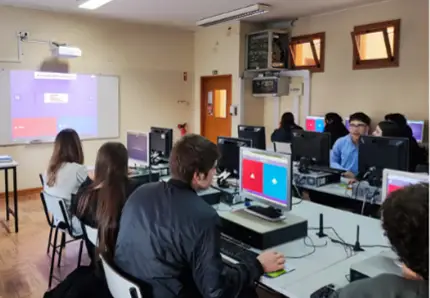
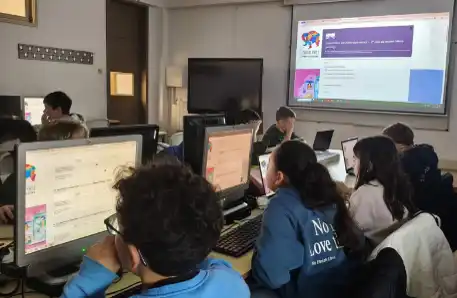
Between February and June 2026, six teachers implemented the pilot project in six primary and secondary education classes, involving 94 students and the contribution of 32 parents and guardians in the impact evaluation process.
The work was carried out in close partnership with three school clusters associated with CFAE-PVVC:
Póvoa de Varzim:
- Aver-o-Mar School Cluster
- Campo Aberto School Cluster
Vila do Conde:
- D. Afonso Sanches School Cluster
The pilot activities focused on two learning scenarios developed within DIGITAL FIRST:
- Learning Scenario 3: Digital Security and Privacy – Regulatory Function.
- Learning Scenario 10: Digital Citizenship, Ethics and Online Collaboration – Regulatory and Representational Functions.
Through these scenarios, students explored tools such as micro:bit, Scratch, SeguraNet and Padlet, connecting the use of digital technologies with questions of privacy, security, responsible behaviour and online collaboration.
What Did the Pilot Reveal?
The Portuguese results revealed differentiated and complementary developments across educational levels.
In primary education, students strengthened their confidence in protecting personal data and significantly increased their confidence in creating and sharing their own digital content.
In secondary education, the project promoted a more critical and conscious attitude towards digital exposure, the risks of online sharing and the validation of information sources.
The monitoring process also included the development of a collaborative portfolio and a teacher focus group held on 30 June 2026, providing opportunities to reflect on the implementation process and share classroom experiences.
Moving Beyond Technical Digital Skills
The Portuguese experience illustrates how informatics education can move beyond learning how to operate digital tools. When technology is connected to meaningful purposes, students have opportunities to communicate, create, collaborate, solve problems and explore ideas.
The purpose of digital education is not simply to develop technical proficiency, but also to help students understand how digital technologies function in society and how to use them responsibly, creatively and critically.
Through teacher training, classroom experimentation and collaborative reflection, CFAE-PVVC contributed to putting the DIGITAL FIRST functional approach into practice, demonstrating the importance of connecting teachers’ professional development with the everyday learning experiences of students.