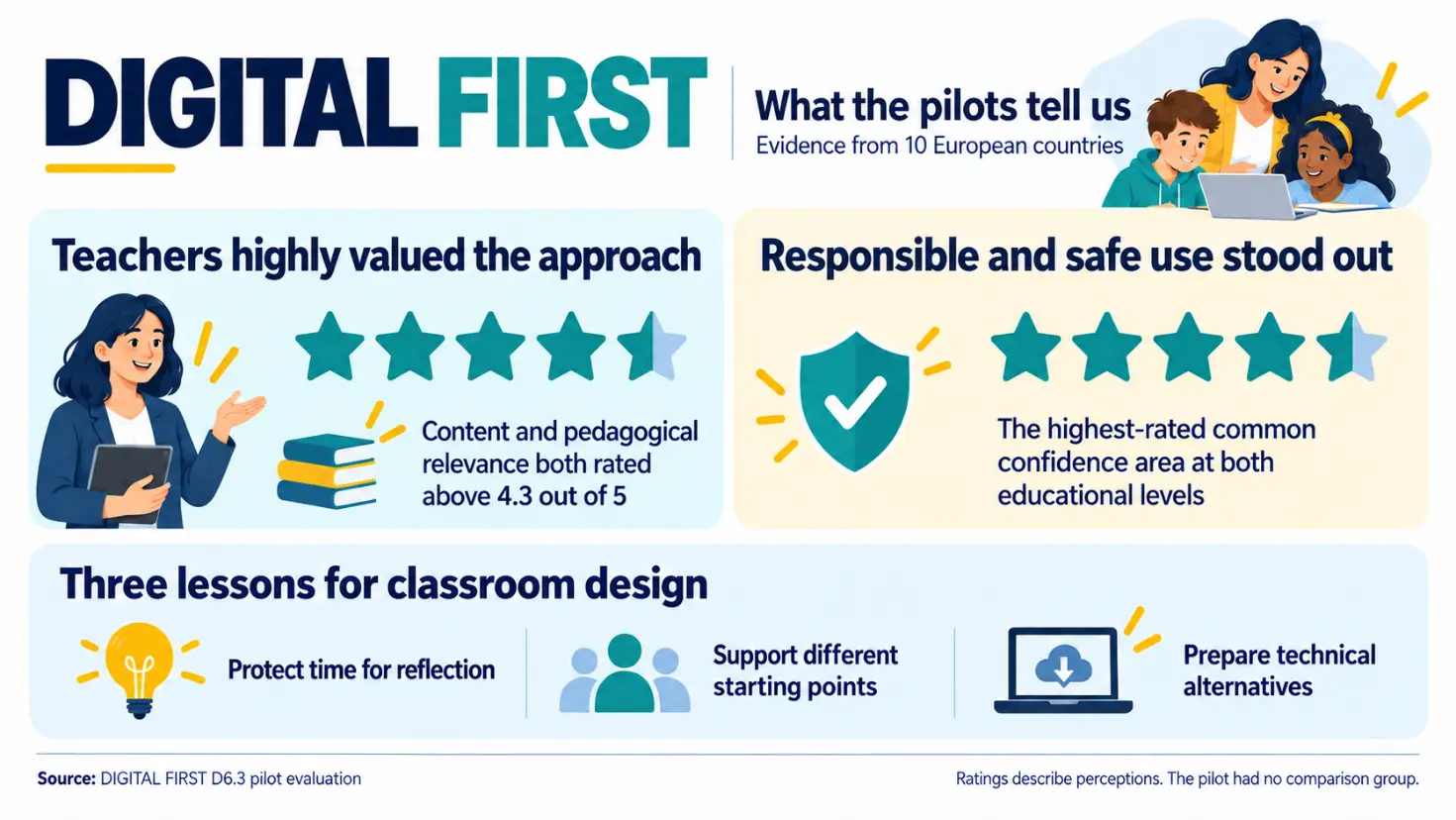

The contemporary Italian classroom faces a silent but significant challenge. While today’s youth are undeniably digital natives, their relationship with technology remains largely passive, centred on consumption rather than creation. To transform this superficial familiarity into genuine capability, Italy requires a systemic overhaul of its national curriculum. The Digital First initiative offers a vital blueprint for this change, presenting a comprehensive proposal to integrate computer science into schools. By aligning digital literacy with the natural cognitive development of youth, this framework offers a progressive pathway from early childhood through to graduation.
In the primary school environment, the curriculum must prioritise the heuristic function of learning. Young children naturally explore the world through intuitive experimentation, trial, and error. Rather than forcing pupils to memorise rigid, text-based code, early digital education should utilise visual, block-based environments. This exploratory approach allows children to discover computational principles through play and immediate feedback. By learning to navigate digital challenges independently, young students build core problem-solving habits and a strong conceptual foundation without facing the frustration of technical syntax.
As students enter adolescence during the middle school years, their educational journey should pivot toward the logical function of informatics. This developmental stage is characterised by a rapidly expanding capacity for abstract thought and systematic analysis. A modern curriculum can leverage this growth by teaching teenagers how to deconstruct complex, real-world problems into orderly, algorithmic steps. This structural training encourages adolescents to look beneath the surface of the software they interact with daily, helping them understand data structures, privacy, and systemic logic, whilst sharpening their broader critical thinking skills.
Ultimately, the high school curriculum should harness these computational foundations to fundamentally revitalise mathematics education. Traditional mathematics teaching in Italy often suffers from an overemphasis on abstract memorisation, leading to student disengagement. By embedding informatics into the syllabus, instructors can make complex math tangible. High school students can write code to simulate algebraic functions, run statistical models, and manipulate geometric structures in virtual space. This cross-disciplinary integration demonstrates to young adults that mathematical equations are not static theories, but rather dynamic, practical tools for solving modern, real-world problems.