Artificial intelligence(AI) and computational thinking are becoming increasingly important in education and everyday life. At the same time, teachers need practical tools and materials that help them teach these skills to learners of all ages in an engaging and accessible way. Some of our partners in the DIGITAL FIRST project are also involved in the AISynergies project, which focuses on developing learning tasks and teaching materials that support problem-solving, logical thinking, and understanding the fundamentals of artificial intelligence.
 The AISynergies project, funded by Nordplus and coordinated by the Turku Research Institute for Learning Analytics at the University of Turku, brings together universities, schools, and organisations from Finland, Denmark, Iceland, Lithuania, and Estonia. Together, the partners are developing new learning tasks related to computational thinking and artificial intelligence.
The project combines the ViLLE learning environment, the Bebras Challenge (https://bebras.org), and AI-assisted development methods to create new learning opportunities for students and teachers.

The aim is to provide teachers with ready-made, easy-to-use tasks that allow students to practise problem-solving, logical reasoning, and the basics of artificial intelligence. The materials are being translated into six languages and can be used either as standalone lessons or as part of broader learning modules.
The project focuses on two main areas:
AI-assisted development of tasks inspired by the Bebras Challenge and creating AI-themed tasks and learning materials.
Development of Tasks
Artificial intelligence offers many new opportunities for teaching, but it also introduces challenges. In the future, digital tools and information will be constantly available, which may easily turn learning into superficial interaction without a real sense of progress. On the other hand, tasks that are too difficult may reduce motivation and prevent students from experiencing success.
To ensure the pedagogical quality of the materials, the development process was carried out in three phases as shown in the picture. 1. Define and design: learning objectives for the new tasks were first defined, and the overall concepts were designed. 2. AI-generated drafts: AI tools then generated drafts of multiple-choice and open-ended questions, together with example solutions.3. Review and refine: teachers and researchers reviewed, tested, and refined the AI-generated content through an iterative process based on feedback and pedagogical evaluation.
The result is a collection of learning materials in which AI serves as an effective support tool, while teachers’ expertise and pedagogical guidance remain at the centre of the learning process.
Supporting Learning Through Immediate Feedback
In the AISynergies project, lessons and learning paths are being developed so that tasks can be assessed automatically and students receive immediate feedback on their work. The exercises are designed to be short and appropriately challenging, helping students recognise the connection between their own effort and learning outcomes.
Learning analytics also helps teachers identify situations where students may need additional support.
The project builds a long-term foundation for teaching computational thinking and artificial intelligence in schools. By combining the ViLLE learning environment, the Bebras competition, and AI-assisted development methods, the project aims to create practical and sustainable solutions for everyday teaching and learning.
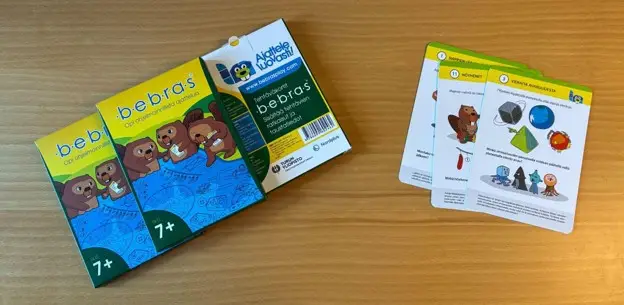
New Bebras task cards are being developed for different age groups and translated into six languages in the AISynergies project.