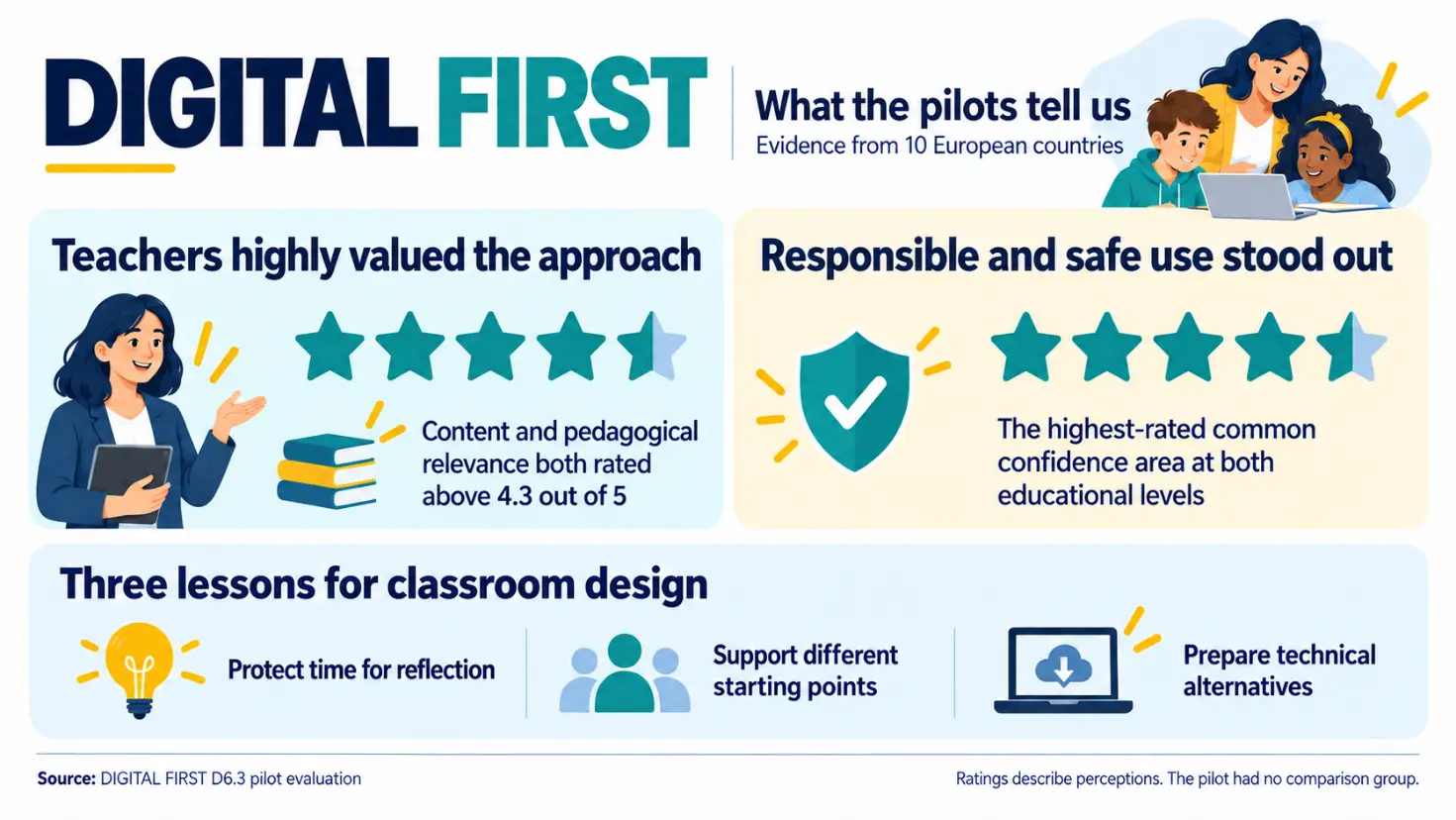
Digital First’s partners published another report titled Competencies Map for informatics teachers in secondary school. It defines the knowledge, skills, and professional dispositions that informatics teachers need at the lower and upper secondary levels (ISCED 24 and ISCED 34).
From Research to Action
Building on previous work that focused on primary education (Competencies map for informatics teachers in primary school), this new study explores what secondary school informatics teachers need to teach effectively and confidently. Similar to the previous work mentioned, the competencies were developed through a multi-step process based on established models, including the Combined Knowledge and Competency (CKC) Model, the Informatics4All reference for informatics content, and the DigCompEdu framework for teachers’ digital competence.
A co-creative workshop held in Ljubljana, a validation survey involving teachers, trainers, researchers, and education authorities, and two online co-created workshops helped refine and confirm the mapping. The results reflect a shared European perspective on the skills required for successful informatics teaching at the secondary level.
Competencies for Teaching Informatics in Secondary School
The document highlights three main domains:
- Subject-specific: Teachers need solid knowledge of Data and Information, Algorithms, Programming, and Privacy, Safety and Security, alongside emerging topics such as Artificial Intelligence (AI), Generative AI, and Modelling and Simulation.
- Pedagogical: Teachers should be able to design engaging and inclusive lessons, apply effective assessment strategies, and integrate active learning approaches suitable for secondary students.
- Transversal: Professional growth, collaboration, ethical awareness, and adaptability are all seen as essential to teaching informatics in a fast-changing technological landscape.
At the secondary level, the focus expands to more complex topics such as Privacy, Safety and Security, Generative AI, advanced Programming, and Modelling and Simulation. Teachers need to help students connect theoretical informatics concepts with real-world applications, fostering critical thinking and digital responsibility. Partners’ validation through workshops and surveys revealed the teachers’ need for advancement, particularly in AI, modelling, and transversal skills.
Across all domains, respondents indicated a clear gap between current and desired competence levels. The project partners evaluated that teachers’ current level of competence is at a basic or intermediate level, while identifying a clear need for teachers to reach higher desired levels of competence, particularly in AI, modelling, and transversal skills. The results also point to the importance of ongoing professional development and institutional support to make these goals achievable in practice.
Practical examples
This report also includes practical classroom examples (separately for lower and upper secondary education) that illustrate how the competencies can be implemented and aligned with the functional approach being developed in the Digital First project. These examples link directly to the Informatics4All framework, ensuring coherence between content, teaching, and professional growth. They are presented in the annex of the report and organised firstly by the secondary level (lower and upper) and then by subject-specific competency areas.
Example of an activity that lower secondary teachers can incorporate in teaching about robotics and physical computing is Building alarm systems with Micro:bit:
- Students design simple alarm systems with Micro:bit that detect when a window or door is opened. Using magnetic sensors or switches, the system triggers an alert wirelessly (e.g. via radio or Bluetooth) to a central Micro:bit acting as a command centre. Students can also programme alarms with sound or light, display warning messages, and log events to a connected computer or cloud service. The activity introduces basic security systems, sensor integration, and wireless communication.
- This activity incorporates instrumental function as students apply digital tools to design and test real-world security systems, regulatory function as they simulate rule-based monitoring and control to ensure safety, and heuristic function as they experiment with sensors and debugging alerts to refine system performance.
Example of an activity that upper secondary teachers can incorporate in teaching about robotics and physical computing is a Smart plant watering system with Micro:bit:
- Students design and build an automated plant watering system using Micro:bit microcontrollers. Soil moisture sensors detect when plants need water, and the system activates a water pump or servo-controlled valve once the moisture level falls below a threshold. LED indicators show watering status, while sensor data is logged to analyse watering patterns over time. Students test the system with real plants, adjust thresholds for different species, research optimal moisture levels, and calculate water efficiency. The project demonstrates sensors, actuators, control logic, and practical applications of embedded systems in agriculture and home automation.
- This activity incorporates instrumental function as students use microcontrollers and sensors to automate plant care, representational function as they document system behaviour with diagrams and data logs, heuristic function as they experiment with thresholds to see how control systems adapt to conditions, interactional function as they collaborate to design, programme, and share automated solutions, and regulatory function as they apply control logic and safety checks to ensure reliable system behaviour.
Towards a Shared Vision
Together, Competencies map for informatics teachers in primary school and Competencies map for informatics teachers in secondary school form a clear, coherent and validated catalogue of competencies for strengthening informatics education across Europe. By clarifying what teachers need to know and be able to do at each educational stage, these reports help inform the design of teacher education programmes, support continuous professional development, and ensure that every learner benefits from well-supported, meaningful informatics teaching.