On 30 June, teachers involved in the implementation of the DIGITAL FIRST pilot in Portugal gathered at CFAE-PVVC (Teacher Training Centre for the School Associations of Póvoa de Varzim and Vila do Conde) for a final focus group, providing an opportunity to reflect on the project’s impact, share experiences from the classroom, and discuss future perspectives. The meeting brought together teachers from the Aver-o-Mar School Cluster (Carlos Mendonça and David Pires), the Campo Aberto School Cluster (Roberto Carvalho and Sara Santos), and the D. Afonso Sanches School Cluster (Ana Madalena Barbosa, Francisco Pinho, and Maristela Cunha), all of which participated in the pilot implementation. The discussion provided an opportunity to analyse the results collected from the 94 students involved, together with feedback from parents and teachers, and to evaluate the effectiveness of the learning scenarios developed throughout the project.
The session confirmed the positive impact of the DIGITAL FIRST functional approach, which focuses on understanding why and how digital technologies are used in human activity, rather than limiting learning to the technical operation of digital tools. Teachers highlighted the project’s potential to strengthen digital competences, foster critical thinking, and promote meaningful digital citizenship across different educational levels.
From Digital Safety to Creative Confidence in Primary Education
The analysis of the Portuguese pilot data revealed a clear connection between the regulatory function of digital technology, associated with safety and responsible behaviour, and the representational function, linked to communication, creativity, and digital expression.
In primary education, this relationship can be described as a progression from protection to creation. As students become more confident in their ability to protect personal information and navigate digital environments safely, they also become more willing to create, communicate, and participate actively online.
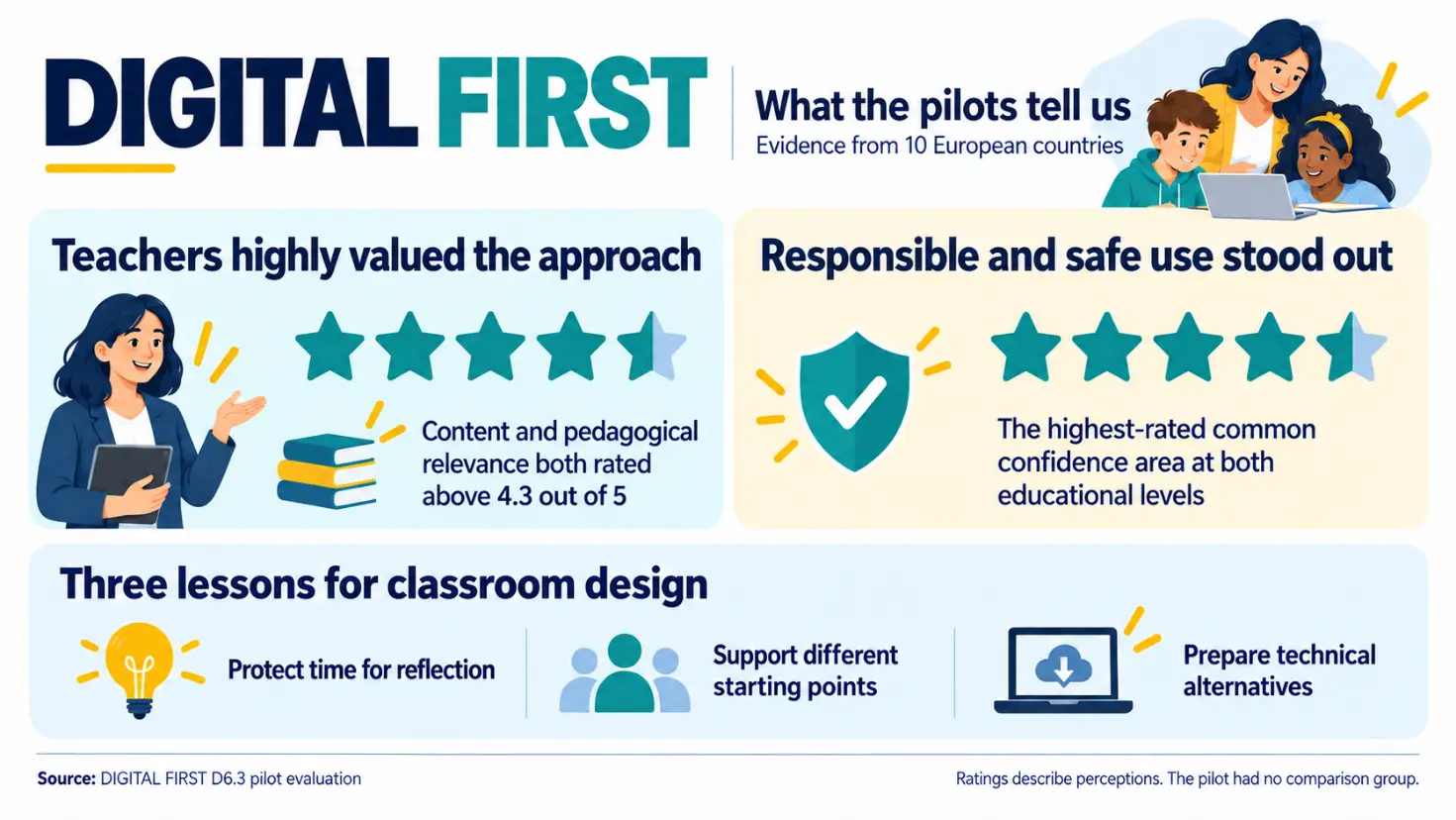
The data demonstrates that nearly 61% of students fully agreed that they know how to protect their personal information, reinforcing their confidence when operating in digital environments. At the same time, there was a significant growth in confidence regarding digital content creation, with the percentage of students feeling fully capable of creating content (such as videos or presentations) doubling to nearly 25%.
Student feedback reinforces this finding. Many pupils identified activities involving Micro:bit, Padlet, Scratch, and collaborative digital projects as the most enjoyable aspects of the pilot. Comments such as*“working with Micro:bit”,“learning new things on the computer”, “using different websites”, and “learning about safe internet use”* appeared repeatedly throughout the feedback collected.
For teachers, these results demonstrate that when students develop a stronger sense of digital safety, they become more confident explorers, creators, and communicators.
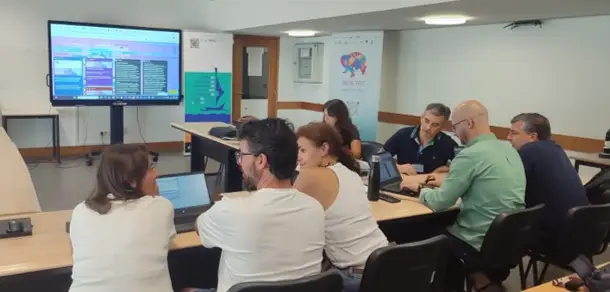 Focus Group Reflection: Primary Teachers (left) and Secondary Teachers (right)
Developing Critical Digital Maturity in Secondary Education
In secondary education, the pilot produced a different, but equally significant, outcome.
Teachers described students’ progression as a shift from “naive self-confidence” to “informed scepticism“, reflecting a higher level of digital maturity and awareness. Rather than simply feeling confident when using technology, students began to question information, recognise online risks, and understand the complexity of digital environments.
The data suggests that students became more cautious when evaluating online information and sharing content. According to the teachers, this should not be interpreted as a reduction in confidence but rather as evidence of the development of critical thinking skills.
Students themselves acknowledged this impact. Several highlighted the importance of learning about online safety, privacy, and responsible technology use. Responses included statements such as:
“I found the classes valuable because they increased my awareness of digital security and privacy.”
“What I liked most about these classes was being able to learn how to take care of my online security in a didactic and fun way.”
“The classes were useful to remind me of the dangers of the Internet and how I can protect myself online.”
For the teachers, the common thread linking both the regulatory and representational functions was the emergence of a stronger critical mindset. Students increasingly recognised that not all online information is reliable, that digital content requires validation, and that responsible participation in digital environments depends on continuous reflection and informed decision-making.
The Teachers’ Perspective
During the focus group, the teachers unanimously highlighted the strong engagement demonstrated by students throughout the pilot.
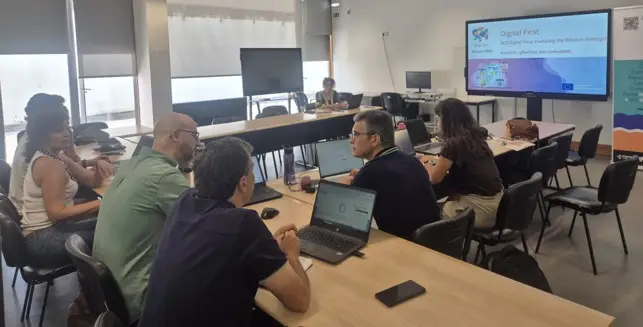 Data Analysis and Reflection at CFAE-PVVC, Póvoa de Varzim
Among the most valued aspects were:
- active student participation;
- collaborative work and peer interaction;
- opportunities for debate and discussion;
- reflection on digital citizenship and online safety;
- practical activities involving digital tools.
One teacher described the most rewarding moments as: “Moments of debate and reflection on the topics. The students participated actively, sharing opinions, experiences, and questions related to the content covered.”
Another highlighted: “The activities of interaction between students, with each other.”
Several teachers also emphasised the satisfaction of observing students’ enthusiasm, collaboration, and willingness to engage with meaningful real-world issues through technology.
Parents Recognised the Impact Beyond the Classroom
The positive impact of the pilot was also recognised by parents.
According to the feedback collected, parents observed that their children became more aware of digital safety, privacy, and responsible technology use. This reinforces the idea that the project’s influence extended beyond classroom activities and contributed to students’ everyday digital behaviours.
Challenges and Recommendations
Despite the positive outcomes, both teachers and students identified several challenges that should be addressed in future implementations.
The most frequently mentioned challenge was time. Teachers expressed the need for additional time to fully explore learning scenarios and allow deeper discussion of key topics. Similarly, many students suggested having more time for practical activities and collaborative projects.
Teachers also highlighted the limitations posed by existing technological infrastructure. As one participant noted, outdated computers and unstable internet connections often hinder the implementation of innovative digital activities.
Students echoed these concerns, suggesting improvements to computer equipment and requesting greater access to digital resources.
The focus group therefore identified three key priorities for future development:
- modernising school technological infrastructure;
- increasing flexibility in learning scenarios;
- strengthening links between DIGITAL FIRST activities and national curricula.
A Significant Step Forward for Digital Education
The conclusions of the focus group reinforce that the DIGITAL FIRST pilot successfully promoted the core principles of the functional approach, encouraging students to understand why and how digital technologies are used, rather than focusing exclusively on their technical features.
The results reveal a strong consensus across the educational community. Teachers validated the pedagogical quality of the learning materials and methodologies; parents recognised increased awareness of safety, privacy, and responsible digital behaviour among their children; and students particularly valued the practical, collaborative, and engaging nature of the learning experiences.
Ultimately, the Portuguese pilot demonstrated that digital innovation in education is possible when a clear pedagogical vision, high-quality resources, and committed educators come together to create meaningful learning experiences. By combining digital safety, creativity, collaboration, and critical thinking, the DIGITAL FIRST functional approach empowered students to move beyond passive technology use and become critical, creative, safe, and responsible digital citizens.