As the Digital First project approaches its conclusion, its core idea remains unchanged. Our experience suggests that functional learning can be a meaningful and effective approach to computer science education. It is not tied to any specific platform or technology: its value lies in how tools are used to support meaningful learning.
Technology Was Never the Goal
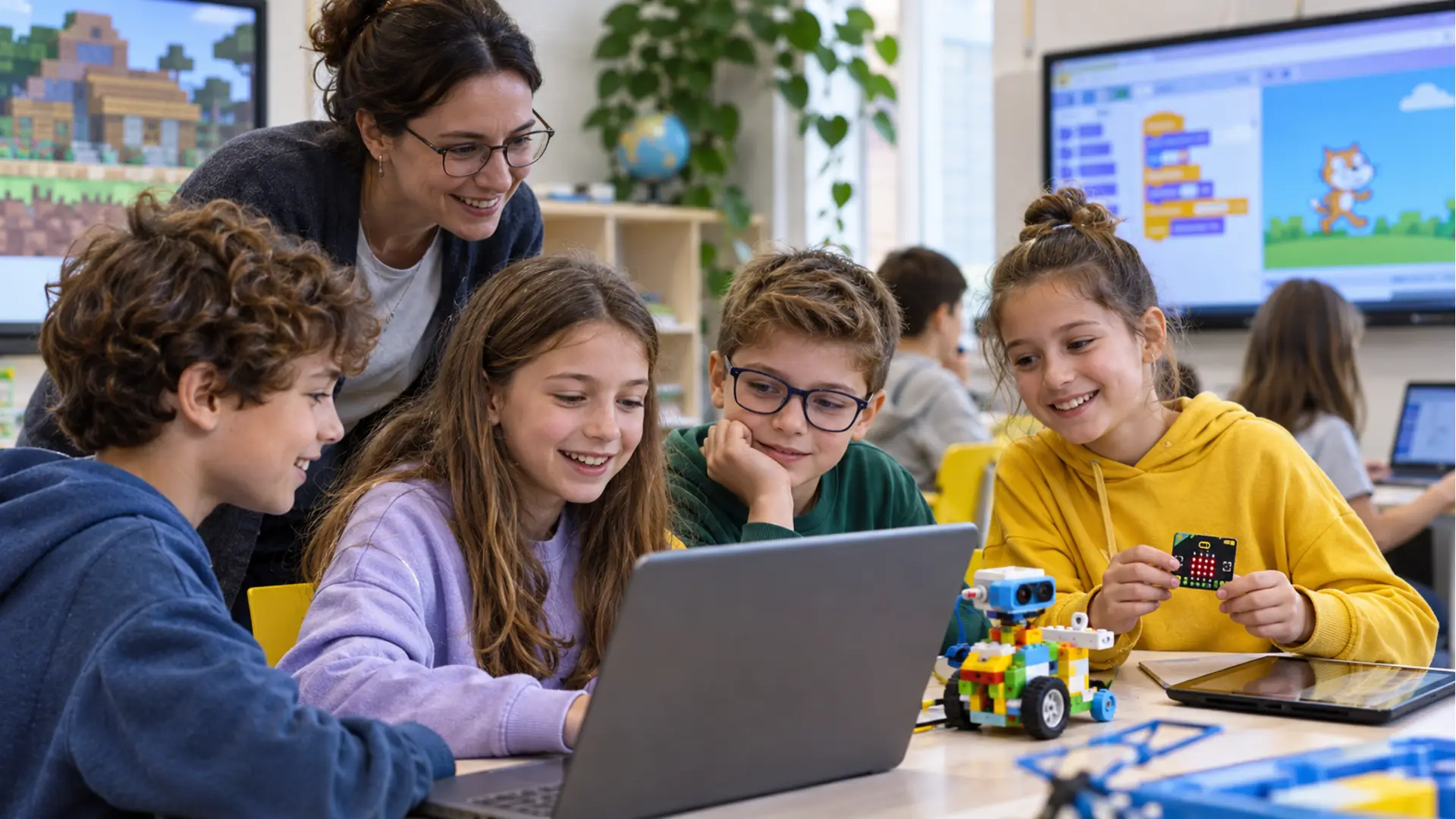
Throughout the project, we used a wide range of technologies, including Microsoft 365 applications such as Word, PowerPoint, Outlook, and OneNote, as well as Scratch, Minecraft Education, Micro:bit, LEGO Education, and various web-based learning tools. Different tools offered different advantages, depending on the learning goals and context. Each brought its own challenges and opportunities.
What mattered most was how technology supported educational goals and the learning journey towards them. Functional learning is shaped by the design of activities and the questions students are encouraged to explore. Technology becomes valuable when it serves a clear educational purpose.
These ideas can take concrete form in activities such as programming the Minecraft Agent to carry out a sequence of actions, creating digital stories in Scratch, exploring inputs and outputs with Micro:bit, and building and programming models with LEGO Education. Each offers a way to connect code with a visible purpose, giving students opportunities to plan, test, revise, and explain their decisions.
The selection of tools and teaching approaches remains the teacher’s responsibility. Appropriate choices depend on students’ prior knowledge, interests and needs, the learning context, and the place of computer science within the broader educational system. A tool that works well for one group or task may need a different approach in another setting. The educational purpose must guide that choice.
Perhaps the most important lesson is the value of using technology to help students solve problems, create, explore, collaborate, and reflect on their learning. Tools will change. Technologies will evolve. These abilities will remain.
Beyond Programming Skills
Throughout the project, we observed that success in computer science education depends on far more than programming knowledge alone. The competencies students brought to and developed through project activities helped shape their work.
One of the most important was perseverance. Project work rarely progresses in a straight line towards success. Mistakes, unexpected results, and technical difficulties are natural parts of learning. When projects encounter obstacles, students’ resilience and ability to remain focused are put to the test.
Communication and collaboration were also important. For primary school students, working effectively with others can be a considerable challenge. They must learn to explain their ideas, listen to alternative viewpoints, negotiate solutions, and share responsibilities. These skills require purposeful opportunities for practice and reflection.
Critical thinking helps students analyse problems, identify the causes of errors, evaluate solutions, and justify their decisions. Combined with effective communication, it supports meaningful collaboration and helps students move beyond trial and error.
Creativity, too, emerged as an important part of learning. It is not simply a matter of random inspiration. Meaningful creativity draws on experience, knowledge, and understanding, allowing students to transform ideas into practical solutions. The process of developing an idea matters alongside the finished product: students need opportunities to explore possibilities, encounter difficulties, and reconsider their approach.
These competencies are valuable across subjects and in future work. Whatever technologies emerge, students will continue to need the ability to persevere, collaborate, communicate, think critically, and create. Programming may open the door, but these competencies enable students to move forward once they step through it.
The Teacher’s Role
These observations lead us to another important conclusion: the teacher remains central to meaningful learning. Even within a functional approach, and despite the growing availability of digital tools, the quality of learning activities depends largely on pedagogical decisions.
The teacher defines the problem, encourages questioning, guides reflection, helps students learn from mistakes, and connects classroom activities with real-world situations. This guidance turns the use of technology into a meaningful learning experience. Digital tools can support this work, but they do not remove the need for a teacher to respond to students’ questions, difficulties, and developing understanding.
The same digital tool can support very different learning outcomes depending on how it is integrated into teaching. Effective practice requires thoughtful planning, clear objectives, appropriate challenges, and opportunities for students to explore, collaborate, and reflect.
This perspective is also reflected in the project deliverable Competencies Map for Informatics Teachers in Primary School (D4.2), which examines the competencies required by computer science teachers and the importance of continuous professional development. It highlights technological knowledge alongside pedagogical expertise, the ability to develop computational thinking, support diverse learners, and adapt to emerging technologies.
As technologies evolve, students need knowledgeable, reflective teachers who can help them evaluate information critically, use technology responsibly, and turn knowledge into meaningful action. This need for thoughtful guidance also shapes how we approach the next question: what happens when the tools students use can generate answers, content, and code?
Looking Ahead to Artificial Intelligence
Today’s students are increasingly likely to work with artificial intelligence systems. This raises an important question: what does this mean for teaching and learning?
Artificial intelligence is neither a magical solution to educational challenges nor a threat to be feared without reflection. Like any technology, its impact depends on how it is understood and used. This places new demands on students and teachers alike.
The growing presence of AI makes understanding algorithms, data, and the principles behind intelligent systems increasingly important. Fundamental computer science concepts remain relevant: they provide a foundation for looking beyond the interface and asking how a system works. Without that understanding, AI risks becoming a black box that is used without being questioned.
An equally important challenge is helping students move from simply using AI tools to critically evaluating their outputs. They need to distinguish reliable from unreliable information, recognise bias, and understand the limitations of AI-generated content. Education must also make space for asking meaningful questions, rather than merely obtaining answers. The quality of the result often depends on the quality of the question.
This highlights the importance of information and data literacy. When content can be generated instantly, the ability to interpret, verify, analyse, and use information responsibly matters as much as access to it.
From the perspective of Digital First, these developments do not require abandoning a functional approach. Authentic problems, exploration, collaboration, and reflection remain central to learning. What changes are the tools and scenarios through which these goals are pursued.
The challenge goes beyond teaching students how to use artificial intelligence. It is helping them understand it, question it, and use it responsibly and effectively.
Conclusion
As the Digital First project comes to an end, we are left with more than a collection of activities, tools, and classroom experiences. We have a clearer understanding of what meaningful computer science education can be.
The functional approach we explored places less emphasis on learning individual tools or isolated programming commands and more on applying knowledge, solving problems, creating meaningful solutions, and transferring learning to new situations. Our experience reinforced the importance of purposeful activities and knowledgeable teachers who can guide students through increasingly complex digital environments.
Artificial intelligence presents new opportunities and challenges, but the fundamental goals remain. Students need to understand how technology works, think critically about information, work with others, and apply their knowledge in unfamiliar situations. In this sense, the principles of functional learning remain relevant as the technological landscape changes.
The Digital First project may be ending, but the journey is far from over. New tools will emerge, technologies will reshape society, and new questions will challenge education. Our task is not to prepare students for a specific technology, but for a future in which change itself is constant.
If there is one lesson we take from Digital First, it is this: functional learning in computer science is not about teaching students to use technology. It is about empowering them to understand it, question it, apply it, and responsibly shape the digital world around them.