
What happens when a common European approach to informatics education meets real classrooms, different school systems, different age groups and different levels of digital experience?
Over the past months, the DIGITAL FIRST project has been finding out.
As part of the project’s piloting phase, learning scenarios developed within DIGITAL FIRST have been put into practice in primary and secondary schools across 10 European countries: Bulgaria, Croatia, Cyprus, Finland, Greece, Italy, Lithuania, Portugal, Slovenia and Spain.
And the scale of the piloting gives us plenty to learn from.
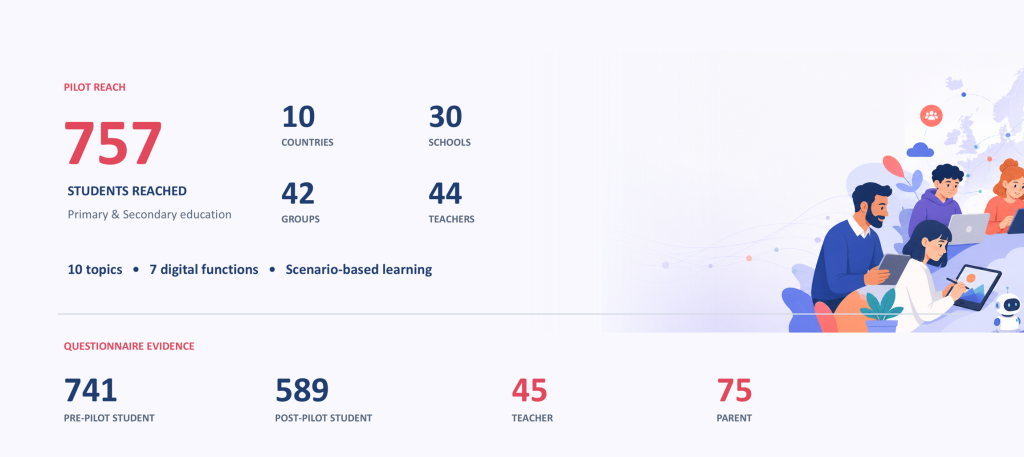
According to the preliminary consolidated data currently being reviewed, the DIGITAL FIRST pilots involved:
- 10 countries
- 30 schools
- 42 implementation groups
- 757 students
- 45 teachers
In addition, the piloting generated a substantial body of evidence, including 741 valid pre-pilot student questionnaire responses and 589 valid post-pilot student questionnaire responses, along with teacher feedback, parent responses, and qualitative evidence from participating countries.
These figures are part of the current working version of the piloting report and may still be refined as the consortium completes its internal review and validation process.
What did students explore?
The pilots covered a broad range of topics that reflect the realities of growing up, learning and participating in an increasingly digital world.
Across participating schools, students explored areas such as digital identity, online communication, privacy and security, media literacy, computational thinking and programming, artificial intelligence, digital creativity, games and gamification, productivity tools, digital citizenship and online collaboration.
Together, the national pilots covered all 10 common DIGITAL FIRST topics and all seven digital functions included in the project approach.
Different countries and schools selected scenarios according to their educational context and the age and needs of their students. Activities ranged from programming, games and digital creation to discussions about AI, misinformation, privacy, online behaviour and responsible participation in digital environments.
What connected them was an emphasis on active, learner-centred and practice-oriented learning.
Rather than simply explaining digital concepts, teachers encouraged students to discuss, investigate, create, experiment, solve problems and reflect.
Ten countries, ten classroom realities
One of the most valuable aspects of piloting across Europe is that the same overall approach inevitably meets very different classroom realities.
The scale of national implementation varied considerably. Some countries worked with smaller groups in one school, while others implemented the scenarios across several schools and classes. For example, the current draft records national pilot participation ranging from 10 students in Cyprus to 188 students in Spain, showing just how diverse the implementation contexts were.
Teachers also adapted activities according to students’ ages, prior experience, available lesson time, curriculum requirements and access to technology.
Some scenarios needed additional explanation or slower pacing. Some activities were divided into smaller steps. In other cases, teachers substituted digital tools, provided additional examples or adapted tasks to better match students’ abilities and classroom conditions.
This flexibility is an important part of understanding whether an educational approach can work beyond a single classroom or national context.
What are we learning so far?
While the detailed analysis is still underway, the implementation reports already provide valuable insight into the realities of teaching informatics across different European contexts.
Across countries, teachers frequently reported strong student engagement when activities were practical, collaborative, creative and connected with students’ everyday digital experiences.
At the same time, recurring implementation challenges included limited classroom time, differences in students’ previous digital experience, technical access, task complexity and the challenge of completing all planned evidence collection before the end of the school year.
These are not yet conclusions about the effectiveness of the DIGITAL FIRST approach. At this stage, the project team is carefully documenting how the pilots were implemented, what adaptations were necessary and what evidence was generated.
The analysis continues
The DIGITAL FIRST consortium is now consolidating and reviewing the information collected across all ten countries.
The forthcoming Report on the Execution of Pilots will provide a structured overview of the implementation process, participation, classroom adaptations, evidence collected and operational challenges encountered during the piloting phase.
A subsequent stage of the project will go further, analysing the collected evidence and drawing conclusions and recommendations from the piloting experience.
So while we can already share a glimpse of the scale of this European classroom experiment — 757 students, 45 teachers, 42 groups and 30 schools across 10 countries — there is still much more to learn from the evidence.
Want to know what we discover next?
Join our DIGITAL FIRST stakeholder list to receive updates on the piloting results, upcoming project resources, events and other developments as the project moves towards its conclusions.