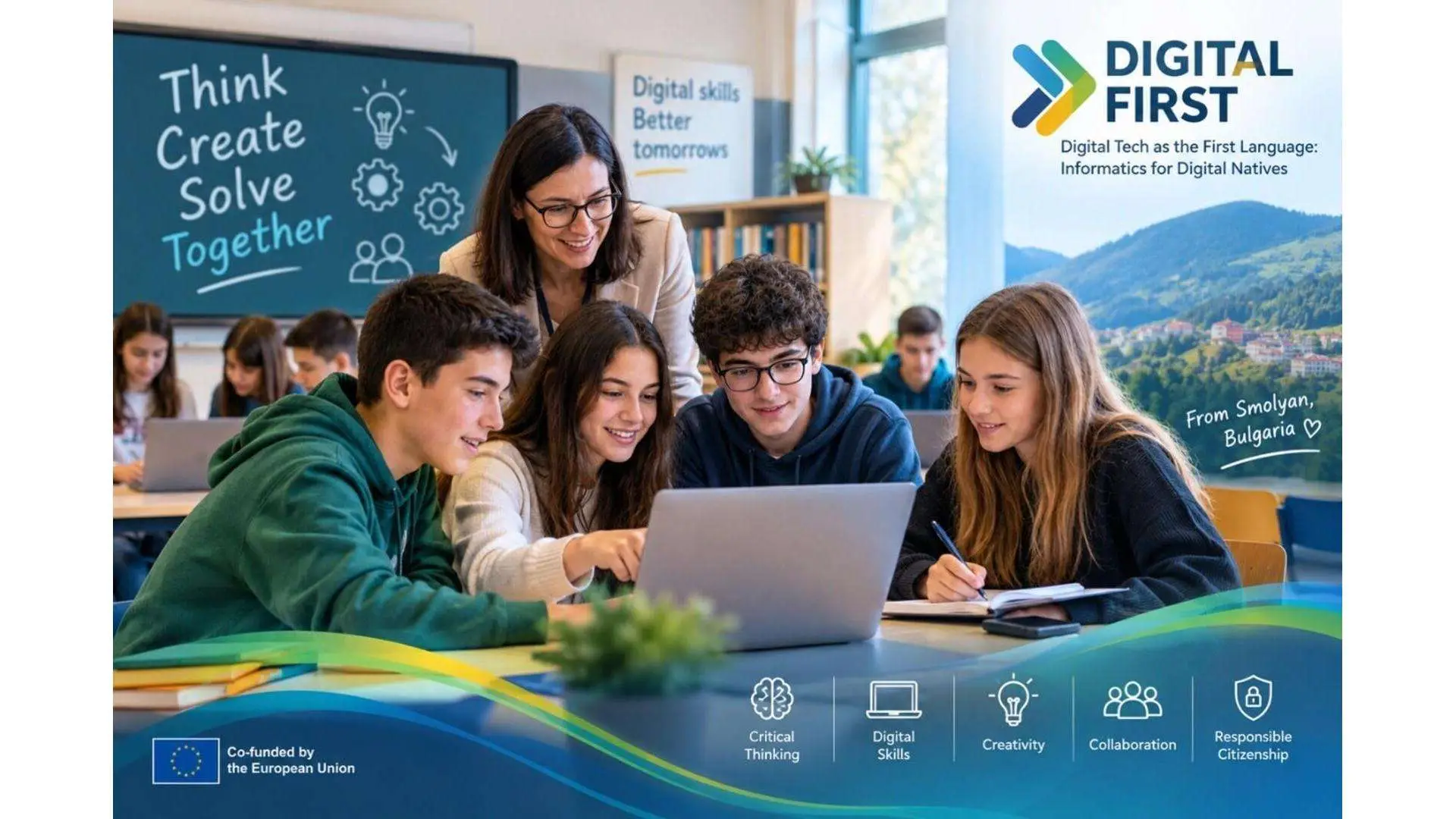
The European “Digital First” project is a strategically significant initiative within the framework of continental educational policy, aimed at redefining the teaching of digital skills and computer science in primary and secondary schools. In Italy, the pilot project conducted at the IIS Ferraris-Pancaldo in Savona has played a pioneering role, situated precisely at the intersection of pedagogical innovation and the reorganization of the technological-vocational education track. The need to move beyond purely transmissive teaching methods—and to align curricula with socio-economic and industrial shifts—finds a rigorous, empirically grounded testing ground in the “Digital First” model.
The project’s institutional architecture is built upon a transnational consortium spanning 10 European countries. Its governance is structured through highly integrated “Work Packages,” which progress from contextual analysis and collaborative discussion to the development and testing of specific models.
At the core of the “Digital First” project lies a departure from the traditional approach to teaching computer science—a model historically rooted in a rote, mnemonic, and purely instrumental perspective (focused on memorizing programming syntax, hardware architectures, or software commands). Instead, the project promotes a shift toward a functional paradigm, in which digital technology is conceived as a computational language, a medium for expression, and a critical tool for interpreting and engaging with the complexities of contemporary society.
In an era defined by the pervasive adoption of generative AI, the “Heuristic Function”—a theme addressed by the Italian team—serves as the cornerstone for the development of “Critical AI Literacy.” The “Digital First” approach counters the passive and uncritical delegation of tasks to machines, transforming the student from a mere end-user of automated responses into an active prompter and rigorous evaluator of the algorithmic system. This heuristic pedagogical method focuses on the engineering of inquiries (informed prompt engineering), the systematic verification of training biases, the analysis of model “hallucinations,” and an understanding of the probabilistic nature of AI-generated output.
The “Representational Function”—another key focus within the Italian framework—is inextricably linked to media literacy, providing students with the epistemological tools to decode the architectures of contemporary information. Through this focus, students learn to deconstruct media manipulation techniques, identify instances of disinformation (such as fake news, deepfakes, and echo chambers), and grasp how the selection, filtering, and visual presentation of data can alter the public’s perception of reality.
The recommendations highlight how the transition to the functional paradigm is unfeasible without a radical revision of the evaluation metrics. Traditional summative assessment — focused on closed-ended tests on theoretical definitions or the mere syntactic correctness of the code — is being replaced by authentic, formative assessment. Learning is detected and expressed through reality tasks (authentic performance tasks), in which students demonstrate their competence through ideation, experimentation, critical discussion and metacognitive reflection on complex digital products, evaluated using multilevel analytical rubrics.
The theoretical-practical structure of the Digital First project presents an absolute convergence with the Italian and European regulatory framework, offering educational institutions transformative tools for the implementation of regulatory reforms.
1. Ministerial Decree 166/2025 (Guidelines for the introduction of AI in schools): The pilot teaching units directly implement ministerial directives on the ethical and pedagogical use of artificial intelligence, promoting the transition from the occasional use of AI to the structuring of guided learning contexts.
2. Ministerial Decree 183/2024 (Guidelines for teaching Civic Education): The transversal integration of Regulatory, Personal and Representative functions fully responds to the goals defined for Digital Citizenship, providing targeted interventions against screen addiction and vulnerability to disinformation.
3. Law 132/2025 and EU AI Act: The model respects the principles of transparency, human supervision and safety of high-risk AI systems established by the European regulation and national legislation, guaranteeing protected learning contexts and compliant with current regulations.
To fully express the potential outlined by the reform of the 4+2 technological-professional chain, functional IT is configured as the integrating factor between the four-year school course and the two-year specialization in the ITS Academy. The acquisition of the 7 technological functions qualitatively enhances the Paths for Transversal Skills and Orientation (PCTO): students do not carry out executive tasks at the host companies, but participate in applied digital innovation projects, bringing advanced problem-solving skills, ethical data management and analysis of business processes.
The adoption of the Digital First model requires formalization within the institution’s PTOF, to be divided into three main directions:
● Explanation of IT functions and digital skills within the disciplinary and transversal curricula.
● Definition of homogeneous evaluation criteria based on observable evidence and performance rubrics approved by the Class Councils.
● Reorganization of teaching in a laboratory and interdisciplinary way, overcoming the rigidity of the single teaching.
Recent ISTAT (national research and statistics body) findings highlight a profound structural contradiction in the Italian youth context: in the face of a very high diffusion of mobile devices among students, a significant digital divide persists linked to the lack of advanced, critical and structured operational skills. Many families experience conditions of infrastructural deprivation (absence of ultra-broadband connections) or cultural deprivation, which confine the use of the internet to passive forms of entertainment or superficial consumption on social media.
The technical and professional institutes, integrated with the reform of the technological-professional supply chain, constitute the main territorial defense to reverse this phenomenon. The application of functional IT responds directly to the needs of the local productive fabric through:
● Raising the competitiveness of graduates: The training of technical profiles capable of understanding computational logic and governing the integration of digital systems in manufacturing and service chains.
● The transition from passive use to digital responsibility: Education in the critical management of online time, awareness of the digital footprint and protection of one’s data.
● Prevention of the risks of information manipulation: The consolidation of a fundamental critical posture for exercising citizenship rights within the knowledge society.
“The real challenge of contemporary school consists in guiding students beyond simple screen dependency, transforming familiarity with digital devices into concrete digital responsibility and technical-functional skills oriented towards the professional future.”
School Principal, in collaboration with network technicians and digital animators, must remodulate the institution’s access policies and web filters. It is necessary to overcome the logic of the indiscriminate blocking of online resources, which penalizes research and precludes the educational use of artificial intelligence. It is necessary to implement transparent and profiled network architectures that combine the protection of minors with the possibility of exploring complex digital environments.
Training of teaching staff must be provided through practical laboratories and classroom simulations. To overcome the obsolescence of fixed laboratories, schools must regulate the adoption of the Bring Your Own Device (BYOD) model. The use of students’ personal devices, inserted into a formal framework of institute rules, transforms the smartphone or tablet from an element of distraction to a professional tool for work and heuristic investigation.
The adoption of functional IT requires forms of time flexibility, such as contiguous time blocks for the realization of real-life tasks and teaching modules co-designed between teachers of different subjects. At the same time, schools must activate involvement initiatives aimed at parents (thematic meetings, summary information on the paths undertaken and spaces for discussion), in order to extend the educational alliance on the issues of responsibility and digital safety also in the domestic environment.