The integration of artificial intelligence and media literacy into the Italian education system is undergoing a profound transformation guided by a precise regulatory framework. The Ministry of Education and Merit (MIM) formalized this pathway with Ministerial Decree No. 166 of August 9, 2025, issuing the Guidelines for the Introduction of Artificial Intelligence in Schools. This regulation fits into the broader legal framework established by Law No. 132 of September 23, 2025, and the European AI Act (EU Regulation 2024/1689), which define schools as deployers of technological solutions and enforce ethical principles alongside a human-centered approach to protect students. At the curricular level, the cross-disciplinary teaching of AI and media literacy connects with the Guidelines for Civic Education established by DM 183/2024 and teacher training initiatives under the PNRR (DM 66/2023).
The necessity for a structured educational intervention is underscored by ISTAT surveys conducted between 2025 and 2026, which outline a national landscape still marked by significant inequalities. In Italy, only 54.3% of individuals aged 16 to 74 possess basic digital skills, a figure that is growing but remains well below the European target of 80% set for 2030. A marked geographical divide persists, with Northern Italy reaching a 60.0% level of basic skills compared to 44.8% in Southern Italy. Practical usage of artificial intelligence also reflects a generational and systemic lag: among young people aged 16 to 24, AI tool adoption stands at 47.2%, remaining below the European average of 63.8%. In this environment, citizens’ informational vulnerability is evident, with 38.3% of the population reporting frequent encounters with false or doubtful news online.
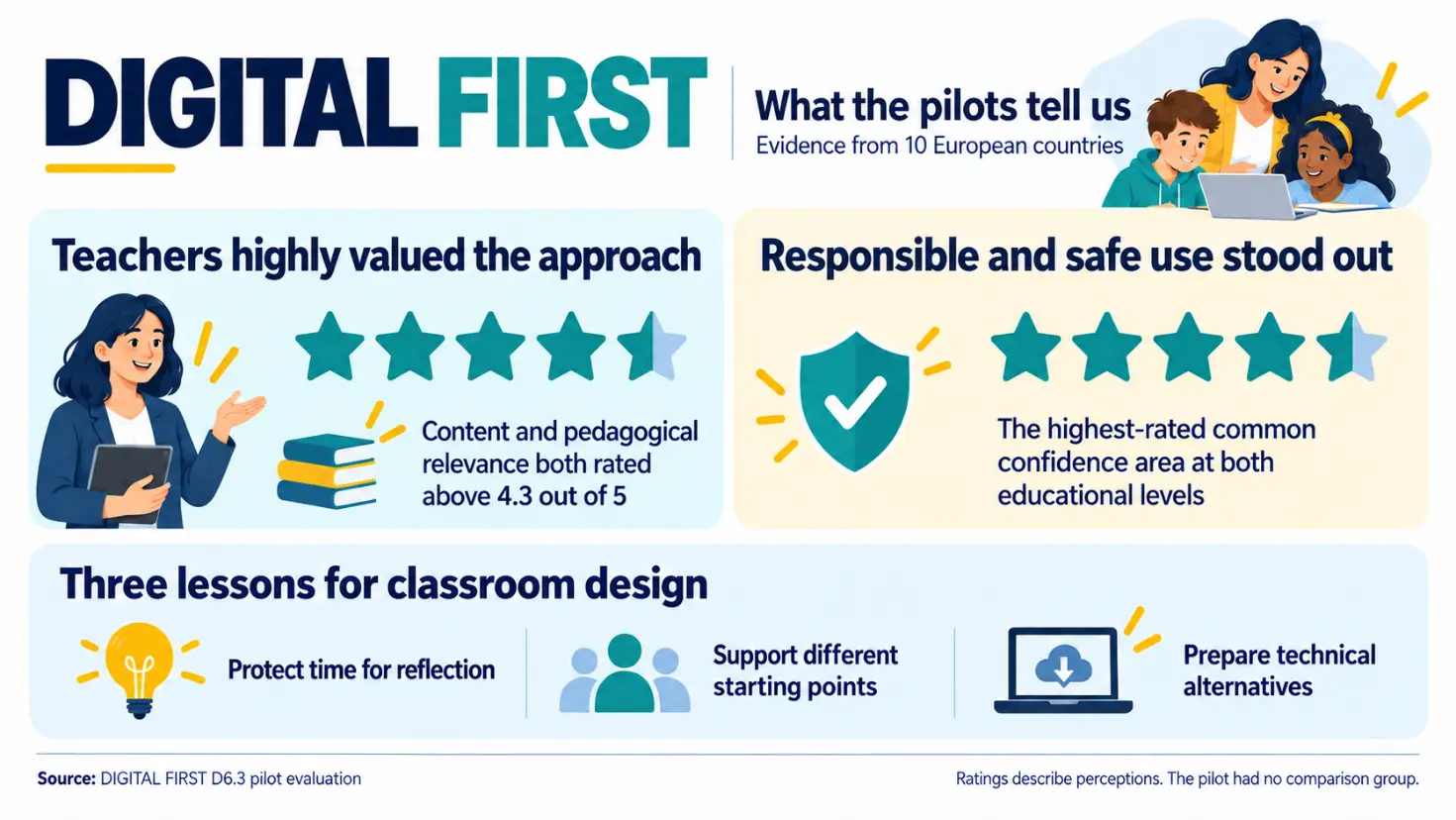
Within this broader landscape, the Ferraris Pancaldo Secondary Education Institute in Savona chose to launch its educational pilot between May and June 2026. This choice was driven by the institute’s participation in the European project Digital First (Digital Tech as the First Language: Informatics for Digital Natives), an international initiative designed to develop new teaching methodologies for digital natives through coordinated pilot runs conducted by European partner institutions. As part of this international framework, the Savona pilot involved twenty-three secondary school students divided into two parallel groups and supported by three teachers.
The educational intervention covered two complementary domains: module T06 (Artificial Intelligence and the Digital Future), focusing on the heuristic function of AI, and module T04 (Media Literacy and Information Evaluation), centering on the representational function of media and information. Methodologically, the teachers adopted an active learning model based on guided discussions, hands-on AI exploration, source-verification exercises, and collaborative problem-solving activities.
Throughout the sessions, students engaged with critical aspects of the contemporary digital environment, exploring AI bias, misinformation mechanisms, algorithmic ethics, source reliability, fact-checking techniques, and algorithmic influence. Two teachers jointly managed the implementation of the AI module, while one teacher coordinated the media literacy pathway. Although teachers valued these learner-centered scenarios, student engagement and perceived learning gains varied, and both institutional support and enthusiasm were uneven across the institution.
The execution of the pilot encountered several operational and structural challenges, including unreliable internet connections, highly uneven prior student knowledge regarding AI, variable student engagement, limited curriculum time, and resistance to allocating instructional time to these topics. To ensure learning effectiveness, teachers implemented targeted adaptations, such as adopting a slower pacing for students with limited prior exposure, introducing teacher-guided verification tasks, and contextually adapting instructional examples.
The overall evaluation of the project drew upon the national report, teacher reflections, and questionnaire responses collected from students and teachers (forms A2, A4, A8, and A10). However, the monitoring process revealed certain methodological limitations: family participation was low, yielding only three completed parent questionnaires and highlighting limited communication of pilot goals to families.
Ultimately, the pilot experience at the Ferraris Pancaldo Institute within the Digital First project demonstrates that bringing together regulatory guidelines, national data insights, and local experimentation is the key path toward integrating AI into secondary education. To transition these pilot efforts into sustained systemic policies, educational institutions must address infrastructure gaps and provide continuous, widespread training for teaching staff. Combining the safety and transparency standards mandated by European and national laws with active, inclusive teaching practices will empower young people with the critical skills required for informed and responsible digital citizenship.