
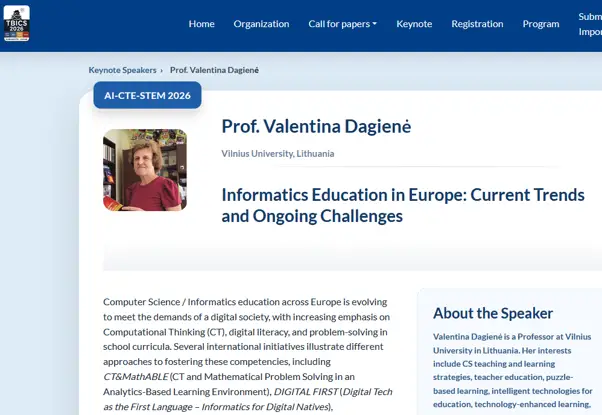
Professor Valentina Dagienė from Vilnius University, Lithuania, was invited as a keynote speaker at the Festival of Learning, organised by the Asia-Pacific Society for Computers in Education (APSCE) in Kumamoto, Japan (https://eds.let.media.kyoto-u.ac.jp/TBICS2026/keynote/valentina-dagiene/). The event brought together researchers, educators, policymakers, and practitioners from around the world to discuss the future of education in the era of Artificial Intelligence (AI), Computational Thinking (CT), and STEM (Science, Technology, Engineering, and Mathematics).
The Festival of Learning marked the 10th anniversary of APSCE’s Theme-Based International Conference Series (TBICS) and featured several co-located international conferences dedicated to emerging trends in digital education. Among them was the 10th APSCE International Conference on Artificial Intelligence, Computational Thinking and STEM Education (AI-CTE-STEM 2026), one of the leading international forums focusing on innovative approaches to teaching and learning.
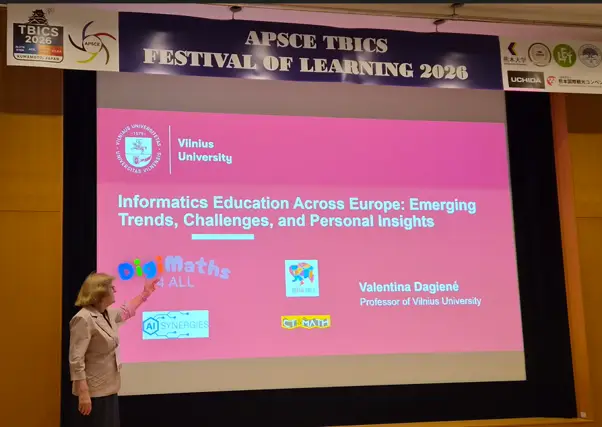
Professor Dagienė delivered the keynote lecture “Informatics Education in Europe: Current Trends and Ongoing Challenges”, presenting an overview of recent developments in computer science and informatics education across Europe. The keynote examined how European countries are modernising school curricula to strengthen CT, digital literacy, programming, problem-solving, and responsible engagement with emerging technologies, competencies essential for today’s digital society.
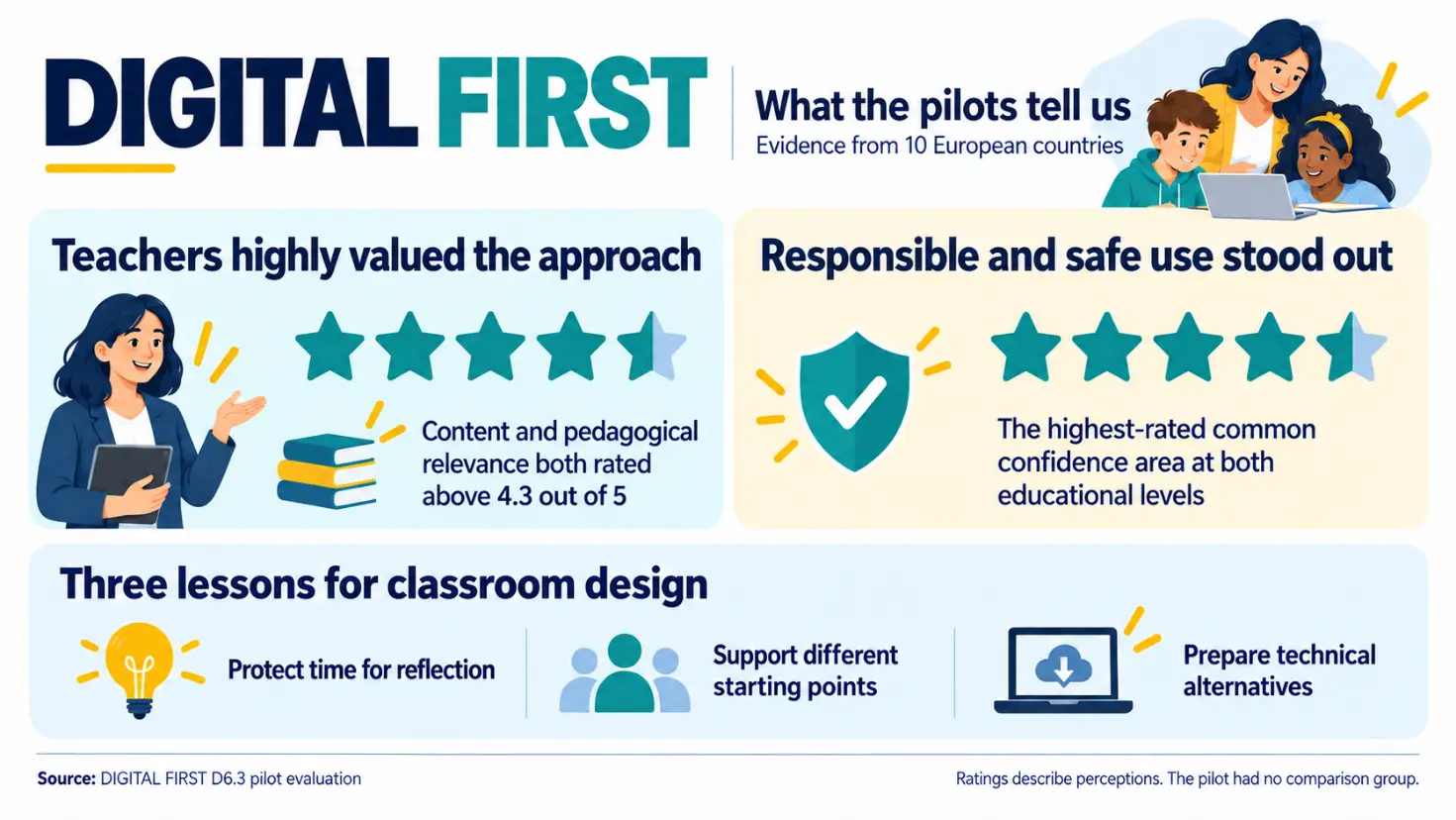
A central part of the presentation focused on the Erasmus+ project DIGITAL FIRST, Digital Tech as the First Language: Informatics for Digital Natives. The project brings together partners from ten European countries to strengthen informatics education through innovative pedagogical approaches, teacher professional development, research-based curriculum reflection, and international collaboration. DIGITAL FIRST supports educators in integrating modern digital technologies into classroom practice while promoting responsible, critical, and creative engagement with digital tools and Artificial Intelligence.
The presentation highlighted how DIGITAL FIRST addresses one of Europe’s major educational priorities: preparing teachers to educate a generation of digital natives. Today’s students often enter school with extensive experience using digital devices, yet this does not automatically mean that they understand how digital technologies work, how data are processed, how algorithms shape digital environments, or how AI-generated information should be critically evaluated. DIGITAL FIRST therefore seeks to bridge the gap between students’ everyday digital experiences and the informatics competencies needed to participate actively and responsibly in the digital world.
Rather than treating technology simply as a collection of tools, DIGITAL FIRST promotes informatics as a fundamental competence for all learners. The project is based on the idea that informatics education should help students become not only users of digital technologies, but also critical thinkers, problem solvers, creators, and informed citizens capable of shaping the digital society. Teachers participating in the project explore innovative methodologies, including heuristic learning, computational thinking, AI-supported learning, creative digital technologies, multimodal learning, gamification, and Universal Design for Learning.
The keynote also provided an overview of the results of an extensive comparative study conducted within DIGITAL FIRST that examined the current state of informatics education across the participating countries. Using document analysis, large-scale teacher surveys, and focus group discussions involving teachers, students, parents, NGOs, and industry representatives, the project explored three key questions: What do we teach? How do we teach it? And are we satisfied with the current informatics education? The study involved more than 1,000 teachers and over one hundred students, providing valuable insights into both the strengths and challenges of informatics education in Europe.
The findings show that European countries share a strong commitment to preparing students for an increasingly digital future. Programming, data and information, CT, digital safety, and problem solving have become important components of modern informatics curricula. At the same time, the research identified substantial differences in curriculum implementation, pedagogical approaches, and teacher preparation. While teachers place considerable emphasis on developing technical competence, logical reasoning, and CT, students increasingly express interest in learning about AI, cybersecurity, digital creativity, and technologies that are directly relevant to everyday life.
Particular attention was given to the pedagogical vision of DIGITAL FIRST. The project argues that informatics education should move beyond traditional teacher-centred instruction and isolated programming exercises toward more active, learner-centred approaches. Inspired by methodologies used in language education, DIGITAL FIRST promotes a functional approach in which students learn informatics through creating, experimenting, communicating, collaborating, and solving authentic problems. This approach aims to make informatics more meaningful, engaging, and connected to real-life contexts.
An important component of DIGITAL FIRST is its focus on teacher professional development. The project recognises that successful curriculum innovation depends not only on new educational content, but also on teachers who feel confident integrating AI, CT, and modern digital technologies into classroom practice. Through international collaboration, pilot activities, professional learning communities, and practical training seminars, the project supports teachers in developing innovative pedagogical competencies while encouraging responsible, critical, and creative use of AI and digital technologies.
The keynote also introduced several complementary European initiatives that collectively illustrate the diversity of approaches to CT education. These included CT&MathABLE, which integrates CT with mathematical problem-solving through analytics-based learning environments; DigiMaths4All, which focuses on strengthening mathematical problem-solving through technology-enhanced learning and CT; and the Nordic–Baltic Bebras initiative, which develops CT learning pathways based on Bebras tasks and supported by learning analytics.
Despite substantial progress across Europe, Professor Dagienė emphasised that significant challenges remain. These include ensuring curriculum flexibility in response to rapidly evolving technologies, addressing shortages of qualified informatics teachers, strengthening teacher education and continuous professional development, improving digital infrastructure and educational resources, integrating AI responsibly into teaching and learning, and developing effective approaches for assessing CT and digital competencies. The DIGITAL FIRST research also underscored the importance of diversity, inclusion, and gender balance, ensuring that high-quality informatics education is accessible and attractive to all learners, regardless of background.
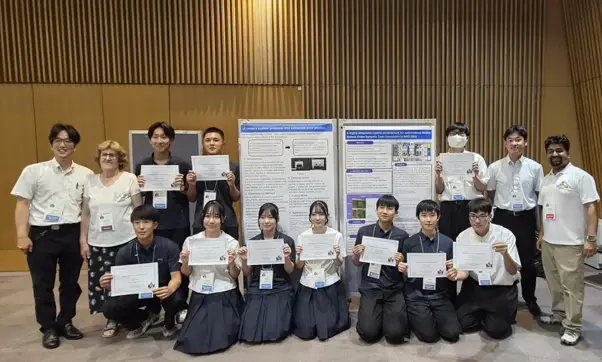
The presentation generated considerable interest among conference participants, particularly regarding European experiences in integrating CT into compulsory education and preparing teachers for AI-enhanced classrooms. Many of the challenges identified by the DIGITAL FIRST project, including curriculum reform, AI integration, teacher preparation, and equitable access to digital learning opportunities, were recognised as common priorities across education systems in Europe and the Asia-Pacific region.
Participation in AI-CTE-STEM 2026 further strengthened Vilnius University’s long-standing collaboration with the international CT education community and provided an excellent opportunity to disseminate the outcomes of European Erasmus+ initiatives to researchers and educators from the Asia-Pacific region. The conference demonstrated that projects such as DIGITAL FIRST are making an important contribution to shaping the future of informatics education, not only in Europe but also within the broader global conversation on preparing learners for an increasingly AI-driven world.