
Digital transformation in education is often measured by device availability, connectivity, or the introduction of new technologies in classrooms. Yet educational research increasingly suggests that these indicators alone tell only part of the story. As the European Commission reminds us through the Digital Education Action Plan (2021–2027), meaningful digital education is not simply about technology adoption; it is about enabling learners to develop the competences, confidence and critical awareness necessary to participate actively in a digital society. This perspective lies at the heart of the Digital First project and has been, predictably, one of the reasons the proposal was submitted for funding.
Rather than asking how students can use more technology, Digital First explores a more fundamental question: how can schools help young people understand, shape and critically engage with the digital world?
The recent pilot activity carried out with secondary school students in Cyprus offers an interesting opportunity to reflect on this question.
Before participating in the pilot, students generally perceived themselves as competent users of digital technologies. This finding is hardly surprising. Today’s adolescents have grown up surrounded by smartphones, social media and online environments. Marc Prensky famously described them as “digital natives”, suggesting that they naturally speak the language of digital technologies. However, subsequent research has questioned this assumption, arguing that frequent use of technology should not be confused with genuine digital competence (Kirschner & De Bruyckere, 2017).
The Cypriot pilot seems to confirm this distinction. While students initially expressed familiarity with digital environments, their responses revealed greater uncertainty when reflecting on more complex dimensions such as managing their digital identity, regulating online behaviour or using technology creatively and responsibly. Most responses clustered around neutral positions, suggesting that confidence did not necessarily accompany experience.
Educational psychology helps explain this phenomenon. Albert Bandura’s theory of self-efficacy argues that learners’ belief in their own capability strongly influences motivation, persistence and future performance. Developing competence therefore requires more than acquiring knowledge; it requires opportunities to experience success, reflect on one’s learning and progressively build confidence.
This is precisely where the Digital First pedagogical approach differs from more traditional models of informatics education. Instead of focusing primarily on programming syntax or isolated technical skills, the project promotes computational thinking, problem-solving, creativity and responsible digital citizenship through authentic learning experiences. This vision closely aligns with the work of Jeannette Wing (2006), who describes computational thinking not simply as a computer science skill but as a universal approach to reasoning and solving problems.
The outcomes of the Cypriot pilot experience provide encouraging evidence that such an approach may foster exactly the type of confidence Bandura describes.
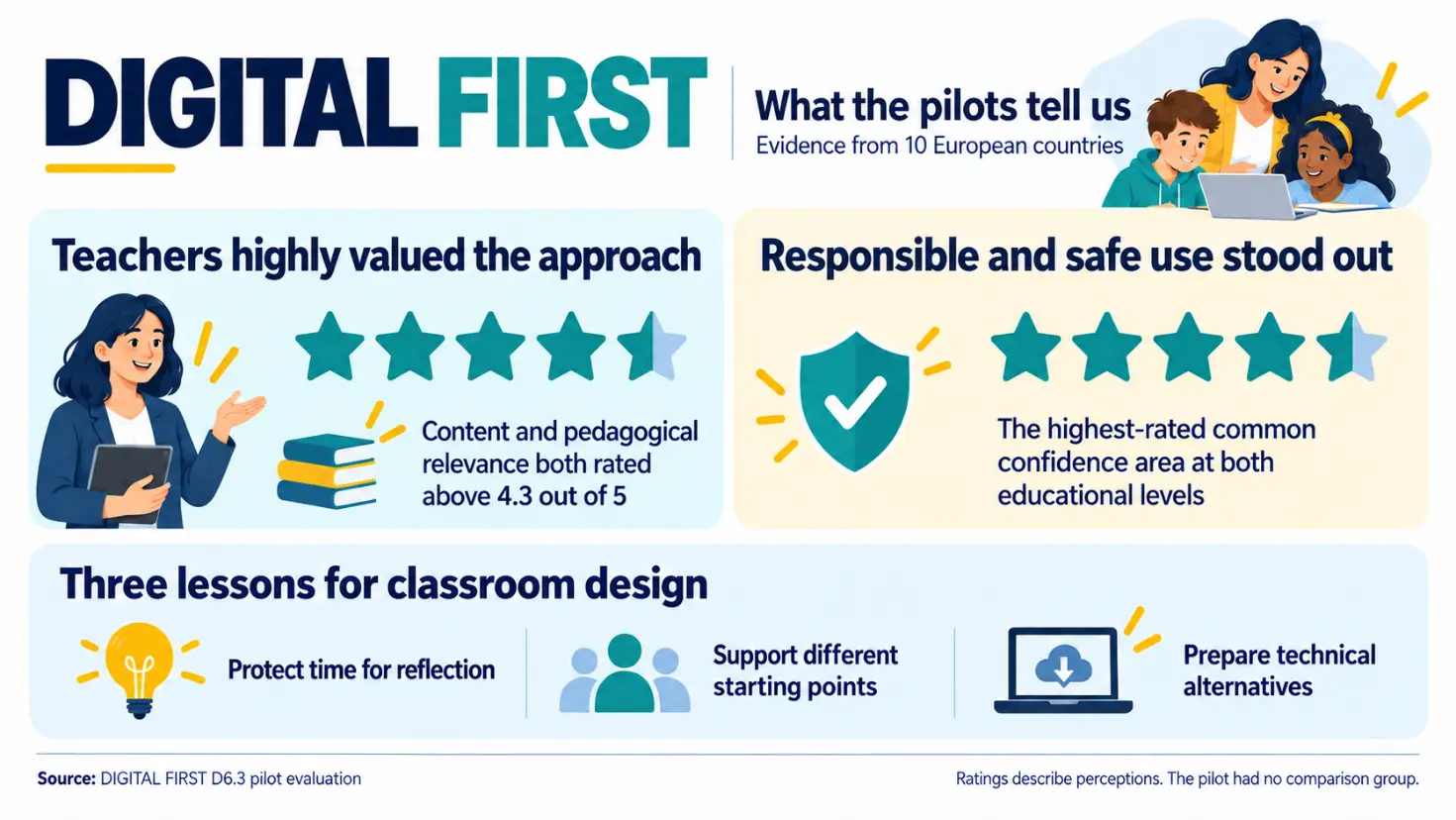
Following the intervention, students reported improvements across every area investigated. Particularly significant were the gains in the Personal and Regulatory Functions, indicating stronger confidence in managing their digital identity, making responsible decisions online and interacting safely with digital environments. Students also expressed very high levels of confidence regarding responsible technology use and the management of their digital presence, while engagement with the learning activities received consistently positive evaluations.
These findings resonate with the European DigComp and DigCompEdu frameworks, which define digital competence as a multidimensional construct including not only technical abilities but also communication, collaboration, safety, problem-solving and critical engagement with digital technologies. From this perspective, digital competence is less about operating software and more about becoming an informed, autonomous, critical and responsible citizen.
Perhaps the most interesting implication emerging from the pilot concerns the role of teachers. Research consistently shows that educational innovation depends less on the technologies themselves than on teachers’ pedagogical capacity to integrate them meaningfully into learning (Redecker, 2017; OECD, 2023). Digital First embraces this principle by placing teachers—not technology—at the centre of educational transformation. Their role evolves from transmitting information to designing learning environments where curiosity, reflection, collaboration and experimentation can flourish.
This reflects a broader shift from what educational theorists describe as instruction-centred teaching towards learner-centred education. As Carl Rogers argued decades ago, meaningful learning occurs when learners actively construct knowledge within supportive relationships rather than passively receive information. In digital education, this human dimension becomes even more important. Technologies may facilitate learning, but teachers remain the professionals who give those technologies educational meaning and understanding in application.
Although the Cypriot pilot involved a relatively small group of learners, it suggests that when informatics education moves beyond a structural approach centred on technical aspects towards a functional approach focused on reasoning, creativity and responsible participation, students not only acquire competences but also develop greater confidence in their own ability to navigate an increasingly complex digital world.
Ultimately, this may represent the most significant outcome of all. Preparing young people for the future is no longer simply about teaching them how technology works. It is about helping them understand why it matters, how it influences society, and how they can contribute to shaping it ethically and creatively. If Europe aspires to build a digitally competent society, investing in pedagogies that strengthen both competence and confidence may prove just as important as investing in technology itself.
References
Bandura, A. (1997). Self-Efficacy: The Exercise of Control. W.H. Freeman.
European Commission. (2020). Digital Education Action Plan 2021–2027: Resetting Education and Training for the Digital Age.
European Commission. (2022). DigComp 2.2: The Digital Competence Framework for Citizens.
European Commission. (2017). European Framework for the Digital Competence of Educators (DigCompEdu).
Kirschner, P. A., & De Bruyckere, P. (2017). The myths of the digital native and the multitasker. Teaching and Teacher Education, 67, 135–142.
OECD. (2023). Digital Education Outlook 2023: Towards an Effective Digital Education Ecosystem.
Prensky, M. (2001). Digital Natives, Digital Immigrants. On the Horizon, 9(5).
Redecker, C. (2017). European Framework for the Digital Competence of Educators: DigCompEdu. Publications Office of the European Union.
Rogers, C. (1969). Freedom to Learn. Charles Merrill.
Wing, J. M. (2006). Computational Thinking. Communications of the ACM, 49(3), 33–35.